Interpret data in various formats and analyze mathematical models
Communicate results in mathematical notation and in language appropriate to the technical field
This section covers the following mathematical concepts.
Calculate Percentages (skill)
Understand and interpret percentages (critical thinking)
Percentages are an often convenient way to express the relative size of two quantities such as the number of people who like lemon meringue pie to the number of those who like pie.
A percent is a ratio of part of something to the whole of that thing that is written as parts per hundred.
Example2.1.2.Calculate a Percent.
In a class there are 34 students. Of them 21 are female. In this case female students is part of the whole (all students). Thus the percent is calculated as
This number says there are 61 hundreths (remembering our numbering system), so the percent is written as 61.76%.
Rounding to two (2) decimal places was chosen to illustrate how we convert a ratio in decimal form to a percent. If we were reporting this information, we would most likely round to 62%. This would convey the same meaning, because the difference between 61.76% and 62% for 34 people is less than one person.
Now that we have presented two examples of calculating a percent from counts, use the check point below to test that you can setup and calculate one yourself.
Checkpoint2.1.4.
In the first pair of examples we had a whole class of 34 students with 21 female and 13 male. Of course 21+13 = 34, that is the two parts add up to the whole. Because of this 61.76% + 38.24% = 100% as well.
Sometimes we are given the size of the whole and a percent, and we are interested in calculating how many are in the part.
Example2.1.5.
In a class of 22 students, 18% are Alaska Native. How many students are Alaska Native?
We use the same setup as before, but we do not know the part yet.
This suggests that the original 18% was rounded. Likely it was rounded to the ones position out of convenience.
We can solve this another way. We know that a percent is a number out of 100, so we can skip a step from the previous example.
\begin{align*}
\frac{P}{22} & = 0.18.\\
P & = 22 \cdot 0.18.\\
P & = 3.96.
\end{align*}
Checkpoint2.1.6.
Sometimes we know the size of a part and what percent it is of the whole. From this information we can calculate the size of the whole.
Example2.1.7.
In a class 2 Alaska Native students make up 6.25% of the class. How many students are in the class?
Again we use the same setup, but we do not yet know the whole.
\begin{align*}
\frac{\text{part}}{\text{whole}} & = \text{percent}.\\
\frac{2}{W} & = 0.0625.\\
\frac{2}{W} \cdot W & = 0.0625 \cdot W. \text{ Move } W \text{ out of the denominator}\\
2 & = 0.0625 \cdot W.\\
\frac{2}{0.0625} & = \frac{0.0625 \cdot W}{0.0625}. \text{ Divide to isolate } W\\
\frac{2}{0.0625} & = W.\\
32 & = W.
\end{align*}
Example2.1.8.How to Use an Example: Percents.
Consider the following question.
If the first chapter of a certain book is 18 pages long and makes up 2% of the book, how many pages does the entire book have?
Because we see “2%” we recognize this as a percent problem. Without more information we can begin writing. In Example 2.1.7 the first step is writing the definition of percent.
In the example 0.0625 is written on the right (in place of percent). In this problem we know the percent is 2. We also know that in a calculation we convert the percent to a decimal. In this case \(2\% = \frac{2}{100} = 0.02\text{.}\) Thus the next step is
In the next step in the example the entries for part and whole are entered. In this problem the 18 pages is stated as one chapter and is contrasted to the “entire” book. Thus the 18 is the part. As with the example, the whole is not known so we leave it as a variable.
Finally in the example they solve for the variable. Note the steps of solving may vary depending on what we know, so rather than follow the rest of the example step-by-step, we apply our algebra skills.
\begin{align*}
\frac{18}{W} & = 0.02\\
\frac{18}{W}W & = 0.02W \text{ Multiply to move } W \text{ out of denominator}\\
18 & = 0.02W\\
\frac{18}{0.02} & = \frac{0.02}{0.02}W \text{ Divide to isolate } W\\
900 & = W
\end{align*}
Thus we know the entire book has 900 pages.
In this next check point the terminology is different but something is still part of a whole and the amount can be calculated using the same approach as above.
Checkpoint2.1.9.
This video covers the topics above.
Subsection2.1.2Percent Increase/Decrease
A common use of percents is to indicate how much something has increased (or decreased) from one time to the next. In these cases the part is the amount changed and the whole is the original amount.
Example2.1.10.
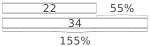
In spring there were 22 students in a class. In the following fall there were 34 students in the same class. What was the percent increase? Round the percent to the nearest unit.
This was an increase of 34-22=12 students. We can calculate what percent the increase of 12 is with respect to the original (spring) class size of 22.
Because the fall class size (in the role of “part”) is greater than the spring class size (in the role of whole), the percent ends up being greater than 100%. For percent increase we should always expect a percent greater than 100%.
Because this is 55% greater than 100%, the percent increase was 55% over the previous semester.
Checkpoint2.1.12.
Example2.1.13.
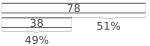
What is the percent increase or decrease if enrollment in a class was 78 in fall and 38 in the following spring? Round the percent to the nearest unit.
Because 38 is less than 78 this is a decrease. Similar to the percent increase we can calculate the decrease first and then calculate the percent. \(78-38=40\text{.}\) Thus the percent decrease is
As with the percent increase we can also start by simply computing what percent the fall enrollment is with respect to the prior spring enrollment. The ratio is \(100 \cdot \frac{38}{78} \approx 0.48717949 \approx 0.49\text{.}\) Because the new enrollment is 49% of the previous enrollment the decrease is 100%-49%=51%.
A long bar labeled 78 is above a shorter bar labeled 38. Their left edges are aligned. The bottom/shorter bar is labeled 49%. The length from the end of the short bar to the (right) end of the longer bar is labeled 51%.
For percent increase problems it may seem fastest to calculate new/old-100% whereas for percent decrease problems it may seem most effective to calculate (new-old)/old. The methods perform the same calculation, so you may choose the one with which you make the correct calculation the most frequently.
Checkpoint2.1.14.
The following example starts with the percent increase information, and determines the original amount.
Example2.1.15.
This year’s sales increased 3% over last year’s sales. If total sales this year were $576,211, how much were last year’s sales?
We can use the usual part/whole definition. It is important to place our information in the correct locations. We are given a percent increase, so we will want to calculate the percent. This is \(100\%+3\%=103\% = 1.03\text{.}\) The amount we are given (this year) is the part; we want to calculate the whole.
\begin{align*}
\frac{\$576211}{W} & = 1.03.\\
\$576211 & = 1.03W. \text{ Clear the denominator}\\
\frac{\$576211}{1.03} & = W. \text{ Divide to isolate } W\\
\$559428.1553 & = W.\\
\$559,428.16 & = W.
\end{align*}
If we want to know what amount constituted the 3% increase of the previous year, we can now calculate that as the difference. $576,211−$559,428.16=$16,782.84. We can confirm it is 3% by dividing \(\frac{\$16782.84}{\$559428.16} \approx 0.029999991\) or 3% when rounded. Notice we needed to compare to the previous year’s amount which was not given.
This video covers percent increase topics.
Subsection2.1.3Limitations
We use percents because they can make the difference in scale between two quantities clear to us. However presenting a percent by itself can be deceptive.
Example2.1.16.
Which of the following do you suppose represents a greater reduction in students?
Percent reduction
Total
18%
495
1.85%
54
60%
5
Solution.
Percent reduction
Total
Number reduced
18%
495
90
1.85%
54
1
60%
5
3
The 18% of 495 represents the largest number of students. The 60% is a higher percent, but because the total is so small it represents very few students. A percent is more useful if we also know the total number.
Did you calculate 89 for 18% of 495? Compare the following to see why both are reasonable responses. 89 is what percent of 495? 90 is what percent of 495?
While percent is defined a parts per one hundred, there are times when percents, sensibly, add to more than one hundred.
Example2.1.17.
Table 2.1.18 contains data from the 2020 U.S. Census. It contains the percent of the state population who checked the box for that race. Note the total is 149.4%. The reason is that a person can select more than one race. As a result a large number of people are counted more than once. Naturally the total is greater than 100 as a result.
When interpreting percents and data in general we should ask about the assumptions are before we draw conclusions.
Table2.1.18.Declared Race in Alaska
Race
Percent
Alaska Native/Native American
21.9%
Native Hawaiian/Pacific Islander
2.5%
Asian
8.4%
Black
40.8%
White
70.4%
Other
5.4%
Exercises2.1.4Exercises
Exercise Group.
Questions about the definition, terminology, and notation.
1.
2.
3.
Exercise Group.
Use percentages in various settings.
4.
5.
6.
7.
8.
9.
10.
11.
12.
13.
14.
15.
16.
17.
18.
19.
20.
21.
22.
Exercise Group.
Check your understanding of percents on these quantitative literacy questions.