
Project 22. Wind Correction Angle.
In flight the direction and speed across the ground of aircraft depends on the speed and direction it is facing and the speed and direction of the wind. In this project we will learn how to combine the two to determine the actual direction and speed and then figure out how to select a direction for the aircraft in order to follow an intended ground track.
(a)
These steps walk through converting the angle and speed into x and y components which may be added. The result is an x and y component for the ground track that we can convert back into an angle and speed. Pilots perform this calculation using a device. We do it manually here to see how those devices perform the calculation.
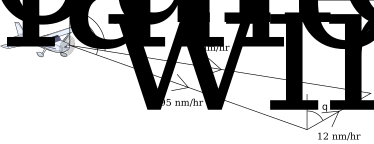
For this task, the aircraft has a heading of 115° and speed of 95 nm/hr. The wind has a heading of 55° and speed of 12 nm/hr. Because we measure angles from straight up instead of to the right, x is the vertical component here and y is the horizontal. This also begins with headings (straight up is north or 0°) instead of angles. If needed, you can review changing headings to angles in Example 7.3.13
(i)
To calculate the x and y components of the plane, we use the right triangle with the 95 nm/hr side as the hypotenuse. The angle in this triangle is the supplement of \(\theta_{plane}\) that is \(\alpha_{plane}=180^\circ - \theta_{plane}\text{.}\) Calculate this angle.

(ii)
Calculate \(x_{plane}\text{.}\)
(iii)
Calculate \(y_{plane}\text{.}\)
(iv)
To calculate the x and y components of the wind, we use the right triangle with the 12 nm/hr side as the hypotenuse (small one on the bottom right of the diagram). The angle in this triangle is \(\theta_{wind}=55^\circ\text{.}\)
Calculate the x and y components.
(v)
To calculate the x component of the ground track we use the right triangle with the unknown nm/hr side as the hypotenuse. In the diagram it has green, dotted legs. What is the x component of the ground track?
(vi)
What is the y component of the ground track?
(vii)
Now that we know the x and y components of the ground track (legs of the right triangle), calculate the ground speed. This is the length of the hypotenuse.
(viii)
Using the side lengths you just calculated, calculate the angle \(\alpha_{ground}\text{.}\)
(ix)
Calculate the ground heading (i.e., \(\theta_{ground}\)).
(b)
When flying the needed ground track (where we are going) and wind are given as is the aircraft speed. We need to calculate the heading for the aircraft to maintain that track. This somewhat reverses the process above. Follow these steps to calculate the required heading (\(\theta_{plane}\)) when we want a ground track (heading) of \(\theta_{ground}=100^\circ\text{.}\) As before our wind is 12 nm/hr from \(\theta_{wind}=55^\circ\text{.}\)
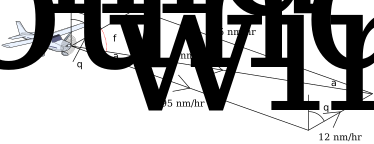
For this calculation we will use this alternate version of the wind correction diagram. Specifically we will use the top triangle. Because it consists of the same three side lengths and directions, the two triangles are similar (actually congruent). It is easier to calculate some angles on this version of the triangle.
(i)
Calculate \(\phi\text{,}\) the angle in the triangle.
(ii)
We know \(\phi\) and the side length opposite it, and we want to know \(\alpha\) (wind correction angle), and we know the side length opposite it. Set up Law of Sines for these angle/side pairs, then solve for \(\alpha\text{.}\)
(iii)
\(\alpha\) is the wind correction angle (how much to turn from the desired ground track). What is the heading (angle from vertical in the diagram) the plane will be facing?
(iv)
Calculate the measure of the third (unlabeled) angle of the triangle.
(v)
Calculate the length of the third side of the triangle. This is the ground speed.
(c)
Finally we consider a quantitative literacy question about the effect of a cross wind on efficiency. When the wind is fully a tailwind (blowing from behind in the same direction we are flying), then the ground speed is the sum of the airspeed and wind speed. When the wind is fully a head wind (blowing from in front in the opposite direction from which we are flying), then the ground speed is the difference of the airspeed and wind speed. The first question then is what is the effect of a wind that is perpendicular to our ground track (neither tail nor head).
(i)
Use the method from above to calculate wind correction angle and ground speed if the ground track is 90°, the wind is from 180° at 12 knots, and the airspeed is 95 knots.
(ii)
Use the method from above to calculate wind correction angle and ground speed if the ground track is 90°, the wind is from 180° at 24 knots, and the airspeed is 95 knots.
(iii)
Does a pure crosswind (no head or tail component) slow down or speed up cruise flight?
(iv)
The final question is whether a wind with a tailwind component always increases ground speed. Calculate the wind correction angle and ground speed if the ground track is 90°, the wind is from 225° at 12 knots, and the airspeed is 95 knots.

