This section will introduce the graph (shape) of quadratic equations, illustrate all the variations that are possible, and demonstrate how these can be used to answer questions.
First we will graph the most basic quadratic equation \(y=x^2\text{.}\) This will show us the basic shape and properties. Later examples will show us the variations and how to control them.
To discover the shape we will graph following the steps shown first in Subsection 3.2.3. First we complete this table of values. We must choose the x values randomly for now.
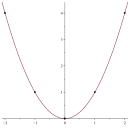
The horizontal axis ranges from -2 to 2. The vertical axis ranges from 0 to above 4. The points from the table above are plotted. On the left the curve starts above the first point and goes down to the middle point then mirrors the same shape going up on the right.
The graph of a quadratic is known as a parabola. Notice that there is a single point at the bottom from which the parabola grows upward to the left and upward to the right. This is known as the vertex. It is at (0,0) for this parabola.
Notice as well that the left and right sides are mirrors of each other. Specifically they are mirrored over the line through the vertex known as the line of symmetry. In this case that is the vertical line \(x=0\text{.}\)
The following example combines three modifications of the basic quadratic. We will graph it, notice the differences, and then use an activity to understand how each part of the equation produces a particular change in the graph.
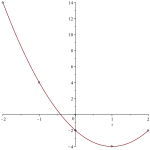
The horizontal axis ranges from -2 to 2. The vertical axis ranges from 0 to above 4. The points from the table above are plotted. The graph looks like the previous parabola except that not all of the right side is shown and the lowest point is not at \(x=1\text{.}\)
The following activity is a set of experiments to understand how each part of the parabola equation works. It is designed to help you understand by seeing the results in calculations. Do these exercises by hand. While you can look up the meaning of each equation part, memorizing them will be harder (and your ability to use them in later chapters reduced) if you do not see how each transformation is caused by the arithmetic.
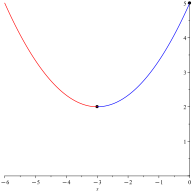
From the activity we know that the vertex location is determined by the numbers added inside and outside the square. In this case the vertex is at (-3,2), because this is \((x-[-3])^2+[2]\text{.}\)
Because the center (axis of symmetry) is \(x=-3\text{,}\) we want to plot a portion of the curve left and right of that value. \(x\) from -6 to 0 (3 left to 3 right) will be convenient.
We can plot the two points we calculate and then sketch the portion of the curve to the right. The portion to the left we then sketch to be symmetrical.
The horizontal axis ranges from -6 to 0. The vertical axis ranges from 0 to 5. The points \((-3,2)\) and \((0,5)\) are plotted. The right side of a parabola is sketched between these two points. To the left the same shape is sketched in mirror.
Recall that lines can all be expressed in the form \(y=mx+b\) where \(m\text{,}\) the slope, defines steepness, and \(b\) represents a shift. Based on the work above we now know that all quadratics (parabolas) can be written as
\begin{equation*}
y=a(x-h)^2+k
\end{equation*}
where \(a\) indicates how steeply the parabola rises, and \(h\) and \(k\) indicate horizontal and vertical shifts of the parabola. The shifts are also the location of the vertex. In the example above we used the shifts to identify the coordinate of the vertex. In applications the shift parameters can have meaning.
Now that we understand what each part of the equation of a parabola tells us, we can use that to interpret quadratic models and answer some questions using a quadratic model.
The lift equation has \(h=0\) and \(k=0\text{.}\) This makes sense because there should be zero lift when there is zero speed. If \(k \gt 0\) then there would be lift at zero speed. If \(h \gt 0\) there would be no lift until that speed.
The coefficients, \(\frac{1}{2}\rho S C_L\text{,}\) make the parabola steeper. This means than increased air density, wing surface area, or coefficient of lift make the increase in lift occur faster with respect to increased speed.
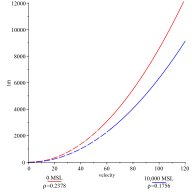
A curve labeled 0 mean sea level (\(\rho=0.2378\)) begins at the origin and climbs to the point \((120,12000)\text{.}\) The graph switches from dashed to solid beyond about \((52,2500)\text{.}\)
A curve labeled 10000 mean sea level (\(\rho=0.1756\)) begins at the origin and climbs to about the point \((120,9000)\text{.}\) The graph switches from dashed to solid beyond about \((60,2500)\text{.}\)
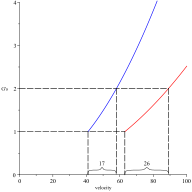
This equation has \(h=0\) and \(k=0\text{.}\) Note the stall speed of a fixed wing aircraft is the slowest speed at which it can fly. Thus the smallest number we will input into the model is \(V=V_S\) which gives us 1 G. That is, the normal state of flight is 1 G (the one produced by earth’s gravity). If \(k \gt 0\) the model would indicate more than 1 G produced by gravity. \(h \ne 0\) would indicate this occuring at some other speed.
The coefficient (\(1/V_S^2\)) indicates that a higher stall speed (divide by a bigger number) will make the increase in G’s slower (graph is less steep). This means it takes a greater increase of speed to move from 1 G to 2 G’s than it does to move from 2 G’s to 3 G’s.
For example if the stall speed is 41 nm/hr, then 1 G occurs at 41 nm/hr and 2 G’s occurs at \(V=41\sqrt{2} \approx 58\) nm/hr. To increase the maximum load factor requires an increase of \(58-41=17\) nm/hr. However if the stall speed were 63 nm/hr then 1 G occurs at 63 nm/hr and 2 G’s occurs at \(V=63\sqrt{2} \approx 89\) nm/hr. To increase the maximum load factor required an increase of \(89-63=26\) nm/hr. The higher stall speed implies a greater (\(22 \gt 16\)) increase in speed.
The next example shows how we can determine the vertex and axis of symmetry even when the equation is not in the easy to read form. Here we use a method that does not require additional algebraic techniques. If you know how to complete the square, that will also work.
Because of the symmetry of a parabola we know that the vertex lies half way between any pair of points with the same height. For example it is half way between two points with \(y=0\text{,}\) that is half way between the solutions to \(2x^2-11x+12 = 0\text{.}\) We can solve this using the quadratic formula.
A model of motion due to gravity is beyond the scope of this course, but we can understand a connection to quadratics. Gravity is a force that accelerates objects toward each other. The strength of earth’s gravity at the surface is approximately 9.80665 m⁄s2. Be aware that this value actually varies a little by location and decreases with altitude, but those effects are not needed for any problems in this book.
Notice that gravity is an acceleration (i.e., m/s is a velocity and this is (m/s)/s meaning a change in velocity) and as a result the time portion is squared. This means accleration due to gravity is quadratic with respect to time.
If we drop a ball from 1.0 meters above the surface, it will start with a velocity of 0 m/s. Acceleration due to gravity is (9.8 m/s)/s which means after one second the ball will be travelling down at 9.8 m/s. After another second (2 seconds total) it would increase (accelerate) another 9.8 m/s so its velocity would be 18.6 m/s.
We can write an equation for the velocity after \(t\) seconds. Notice that the change in velocity is a constant, so the change in velocity is a linear equation. The rate (slope) is 9.80665 m⁄s2. The shift is the initial velocity (0 m/s in this case).
Calculating the exact height of an object falling due to gravity requires mathematics beyond this textbook. A little more information can be found in Section 5.5. The following example illustrates calculations using a provided simplification.
Because the object is dropped, the heighest point is when it is dropped which is time \(t=0\text{.}\) Thus the height from which it was dropped is \(-4.9(0)+1.0=1.0\) meters.
Example5.4.10.Gravity’s Effect on a Thrown Object.
Consider an object that is thrown upward. Gravity will first slow down the object as it climbs, then it will cause the object to fall (as in the previous example). Suppose the height of this object is given by
We can determine this by solving the \(-4.9t^2+5.1t+1.2=0\text{.}\) To do this we can use the quadratic formula. All numbers have two significant digits and are precise to the 10ths.
We use any two points. In the previous step we found the two times when the height is zero. It does not matter that one is negative: this will still work to locate the vertex. The time at which the maximum height occurs is