In some circumstances a ratio is fixed. By fixed ratio we mean that no matter which data points we select, we obtain a ratio with equal value. For example when we scale a recipe the ratio of flour to water must remain the same if we make one recipe or double it. These circumstances are called proportions. An example of a non-fixed ratio is a bobble head toy. The head has a different scale (ratio of toy head size to real head size) than the body does.
Fixed ratios make sense in examples like conversion of units. For example 1 gallon is always 4 quarts. In contrast rates often change: your average speed may be 25 mph, but you must have driven slower and faster during that drive. For the ratios that do not change we can write equations and solve for properties.
Because a proportion means a ratio is fixed, we can write the first ratio equals the second ratio. This gives us an equation to solve. There are multiple ways to solve these, each of which is demonstrated below.
The first example shows a straight forward proportion with the simplest solving method. This method uses the same algebra steps as solving a percent problem.
A particular cheesecake recipe calls for \(150\) g of eggs and \(1500\) g of cream cheese. How many grams of eggs and how many grams of cream cheese do we need to double the recipe?
This means everything will be in ratio of 2 (needed)/1 (in the recipe). We must perform the calculation for eggs and cream cheese separately. We want the ratio of amount of eggs in the doubled recipe to the amount of eggs in the original recipe to be 2/1. Thus
In commercial recipes (and quality home cooking) weights are used because items like eggs are not uniform in mass. If we always use 3 eggs (average total weight 150 g), it might be more (e.g, 152 g) or less (147 g) than we need which will result in the food not turning out right.
First, we determine the ratio for scaling. We want 6 dozen and the recipe makes 4 dozen so our ratio is \(6/4 = 3/2\text{.}\) Thus to determine the amount of flour needed we set up the proportion
A model of a space shuttle is labeled as 1:144. This means one inch on the model represents 144 inches on the actual shuttle. We can express this as a ratio between the size of objects on the model and the size of the objects on the actual shuttle. If we want to know how large a part of the shuttle is and we know on the model it is 1.72 inches we can set up the proportion
\begin{equation*}
\frac{1 \text{ model inches}}{144 \text{ inch}} = \frac{1.72 \text{ model inches}}{s \text{ inch}}\text{.}
\end{equation*}
Because a ratio expresses the relationship between two quantities, it is not important which is numerator or denominator. Thus it is equally valid to write
\begin{align*}
\frac{144 \text{ in}}{1 \text{ model in}} & = \frac{s \text{ in}}{1.72 \text{ model in}}.\\
\frac{144 \text{ in}}{1 \text{ model in}} \cdot 1.72 \text{ model in} & = \frac{s \text{ in}}{1.72 \text{ model in}} \cdot 1.72 \text{ model in}.\\
247.68 \text{ in} & = s.
\end{align*}
When we experience math in the wild, problems do not come labeled with solving methods. We must recognize the math and apply our knowledge appropriately. The next example illustrates identifying ratios (proportions) more than once when answering a question.
Suppose a Diamond DA-20 climbs at the rate of \(\frac{550 \text{ feet}}{1.0 \text{ minute}}\) and is traveling \(\frac{72.8 \text{ nm}}{\text{hour}}\) across the ground during this climb. How far forward in nautical miles does the plane fly during a climb of 3500 feet? Round the final distance to one decimal place.
Looking at the information we are given, only two pieces match initially: we have a climb rate and a distance to climb. Thus we will use these first. As before we can calculate how long it will take to climb.
Now we know how long the plane flies during this climb. This time matches with the other rate: speed across the ground. However, the units do not match. We must first convert the speed to feet per minute or the time to hours. We use conversions from Table 1.1.2.
A recipe for hush puppies calls for 150 g of flour for 340 g of buttermilk. If we have 465 g of flour and 918 g of buttermilk, how much of the flour and buttermilk can we use? Which one constrains us (limits size of our batch)? Quality kitchen scales are accurate to a single gram which determines our rounding.
The ingredients must remain in the ratio \(\frac{340 \text{ g buttermilk}}{150 \text{ g flour}} = \frac{34 \text{ g buttermilk}}{15 \text{ g flour}}\text{.}\) We can select either ingredient and see how much the ratio tells us we need of the other ingredient.
Because we do not yet know which ingredient is limiting we will suppose we use all 465 g of flour. Then we can set up the proportion
\begin{align*}
\frac{34 \text{ g buttermilk}}{15 \text{ g flour}} & = \frac{B \text{ g}}{465 \text{ g flour}}\\
\frac{34 \text{ g buttermilk}}{15 \cancelhighlight{\text{ g flour}}} \cdot (465 \cancelhighlight{\text{ g flour}}) & = \frac{B \text{ g}}{\cancelhighlight{465 \text{ g flour}}} \cdot \cancelhighlight{(465 \text{ g flour})}\\
1054 \text{ g buttermilk} & = B.
\end{align*}
Notice that this is more buttermilk than we have. That means the buttermilk is the limiting ingredient. We will be able to use all of the buttermilk, but only some of the flour. To determine how much we setup the proportion but this time solve for flour.
We will use all 918 g of buttermilk. Then we can set up the proportion
\begin{align*}
\frac{15 \text{ g flour}}{34 \text{ g buttermilk}} & = \frac{F \text{ g}}{918 \text{ g buttermilk}}.\\
\frac{15 \text{ g flour}} {34 \cancelhighlight{\text{ g buttermilk}}} \cdot (918 \cancelhighlight{\text{ g buttermilk}}) & = \frac{F \text{ g}}{\cancelhighlight{918 \text{ g buttermilk}}} \cdot \cancelhighlight{(918 \text{ g buttermilk})}.\\
405 \text{ g} & = F.
\end{align*}
Thus we can use all 918 g of buttermilk and 405 of the 465 g of flour. We have rounded everything to one gram because that is as accurate as we can measure with our scale. If a single recipe uses 340 g of buttermilk, then we will be making
There is an alternate way to determine which ingredient limits our scaling up. We know the recipe calls for a buttermilk to flour ratio of \(\frac{34}{15} \approx 2.266666667\text{.}\) We can calculate the ratio of the ingredients we have on hand. \(\frac{918}{465} \approx 1.974193548\text{.}\) This is less than the required ratio, which means the numerator is too small. Thus we have too little buttermilk. From here we can continue to calculate the usable amount of flour as in the previous solution.
This section presents a geometric fact which is expressed as proportions. This geometry can be used to solve for distances or lengths in some circumstances. First we define and illustrate the geometric fact.
Corresponding means we have paired angles on one triangle with those on another. So this definition says that each angle on one triangle can be paired with one on the second triangle that has the same measure. This allows us to define corresponding sides as well. Two sides from the different triangles are corresponding if they are across from angles of the same measurement. When triangles are similiar their corresponding side lengths are proportional. This is illustrated in the following example.
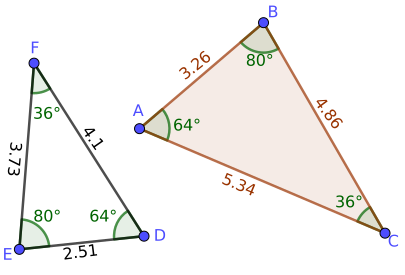
The triangle with vertices A, B, C has angle measure 64° at A, angle measure 80° at B, and angle measure 36° at C. Side AB has length 3.26; side BC has length 4.86, and side CA has length 5.34.
The triangle with vertices D, E, F has angle measure 64° at D, angle measure 80° at E, and angle measure 36° at F. Side DE has length 2.51; side EF has length 3.73, and side FD has length 4.1.
The triangles \(\triangle ABC\) and \(\triangle DEF\) are similar. Notice that the angles at \(A\) and \(D\) have the same measure (64°). The same is true of the angles at \(B\) and \(E\) (both 80°) and the angles at \(C\) and \(F\) (both 36°). These are the corresponding angles: A and D, B and E, and C and F.
\(BC\) is the side opposite the angle at \(A\) and \(EF\) is the side opposite the angle at \(D\text{.}\) Because \(A\) and \(D\) have the same measure, the sides opposite them are corresponding sides.
Similarly \(CA\) is the side opposite the angle at \(B\) and \(FD\) is the side opposite the angle at \(E\text{.}\) Because \(B\) and \(E\) have the same measure, the sides opposite them are corresponding sides.
Move one of the corners of the bottom triangle around which will change the size of that triangle. As you do, notice that the side lengths change, but the two ratios of side lengths remain the same. Every ratio of corresponding sides would be the same.
Repeat the experiment by moving one of the corners of the top triangle. This will change the shape of both triangles (they will remain similar). Notice that the ratios remain the same.
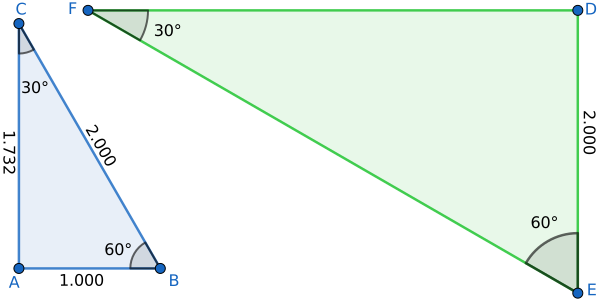
Suppose triangle ABC has angles \(90^\circ, 60^\circ, 30^\circ\) with the lengths of the sides opposite them \(2.000, 1.732, 1.000\) respectively. If triangle DEF also has angles \(90^\circ, 60^\circ, 30^\circ\) it is similar. Suppose the length of the side \(DE\) opposite the \(30^\circ\) angle at point F is \(2.000\text{.}\)
First, we identify the corresponding sides. \(\overline{AB}\) and \(\overline{DE}\) are opposite \(30^\circ\) angles so they are corresponding. \(\overline{CA}\) and \(\overline{FD}\) are opposite \(60^\circ\) angles so they are corresponding. Finally, \(\overline{BC}\) and \(\overline{EF}\) are opposite \(90^\circ\) angles so they are corresponding. This means
Because we know the ratio \(\frac{\overline{AB}}{\overline{DE}}\text{,}\) we can use the proportion to solve for the other two side lengths on triangle DEF. We invert the ratios for easier solving.
Similar triangles can be found in a variety of circumstances. This example recognizes similar triangles in a context where we want to calculate rather than measure a length. This method of indirect measurement has been used many time in history.
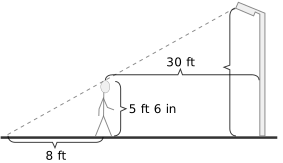
A person is standing 30 ft from a light pole. The shadow cast by the light is 8 ft long. If the person is 5 ft 6 in tall, how high is the point on the light that is casting the shadow?
We can start by looking at the image. In it we spot multiple triangles. Two, right triangles will be useful for calculating the height. The smaller one has legs of length 8 ft and 5 ft 6 in. The third side (hypotenuse) is the dashed gray line, but we will not need it. The other right triangle we can use has a leg that is the entire bottom (length 8 ft plus 30 ft). Its other leg is the height of the light.
Let’s compare the angles of the triangles. If we suppose the light post is straight up and the person is standing straight up, then the angles at the persons feet and the base of the light are right angles and thus the same. The triangles share the angle on the left (between dashed line and ground), so that matches. The third angle must match because the first two do; we will explain why in Theorem 7.1.1.
Because all the angles in these triangles are the same, the triangles are similar. We can use the proportionality of corresponding side lengths to calculate the height of the light. Before we do, we will convert the height of the person to decimal. Using a conversion from Table 1.1.2, 5 ft 6 in is 5.5 ft. The proportion of corresponding sides is
If these measurements were taken with a tape measure we can reasonably suppose they are accurate to the nearest inch. We can convert the 0.125 ft into inches and then round.
We use this type of measurement because it is simpler: we can measure across the ground much more easily than we can climb the pole and measure its height. It was not important that the person chose to be 30 ft from the pole. If they chose to be 20 ft, then the shadow would also be shorter (proportional). If we are too close it will be hard to accurately measure the short shadow (ever try to measure a shadow?).
Shapes other than triangles can be similar. For example there are similar rectangles and similar pentagons. To be similar they must have the same number of sides, corresponding angles must be the same, and corresponding sides must be in the same ratio. Just having the same angles is insufficient: any two rectangles have all the same angles (right angles) but not every pair is similar.
One place where similar shapes (beyond triangles) is used is scale drawing and scale models. If you ever built a model of a car or a plane or some such there was most likely a scale given. For example they may be 1/32 scale. This means that one inch on the model is 32 inches on the actual object.