Section 4.1 presented areas of triangles and a relationship between the three sides of a right triangle. This section and the following ones present relationships between angles of triangles and the lengths of their sides.
The Pythagorean Theorem states a relationship between the side lengths of all right triangles. There is also a relationship between the three angles of all (not just right) triangles.
We know the measure of one angle is \(90^\circ\) (right angle) and the measure of another angle is \(55^\circ\text{.}\) Thus the third angle must satisfy
For a right triangle each of the other two angles have measure less than a right angle. This is a result of the Triangle Angle Sum theorem. \(180^\circ-90^\circ=90^\circ\) so the remaining two angles have a sum that adds to \(90^\circ\text{.}\) This implies both non-right angles are smaller than a right angle.
This section presents the trigonometric functions and demonstrates that they make sense. First, we need terminology with which to describe right triangles.
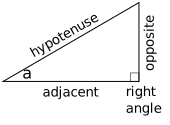
For right triangles we have names for the sides. Consider the labels in Figure 7.1.5. These names are relative to the particular non-right angles with which we are working. In this case it is the one labeled \(\alpha\text{.}\) The adjacent is the side that connects the angle \(\alpha\) and the right angle. The opposite is the side touching the right angle but not touching the angle (\(\alpha\)). Both the adjacent and opposite sides are known as legs of the right triangle. The hypotenuse is opposite the right angle (the one side not touching it).
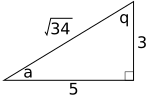
Consider the triangle in Figure 7.1.8. With respect to the angle \(\alpha\) the adjacent side is the one with length 5, and the opposite side is the one with length 3.
The hypotenuse has length \(\sqrt{34}\text{.}\) The angle on the right side of the hypotenuse is \(\theta\text{.}\) The length of the side to the right is 3. The angle on the left side of the hypotenuse is \(\alpha\text{.}\) The length of the side on the left is 5.
Now that we have defined trigonometric functions, we can use them to analyze triangles. The goal is to calculate all of the side lengths and/or angles given only some of them.
First, we know that two of the angles are \(90^\circ\) and \(50^\circ\text{,}\) so the third angle has measure \(180^\circ-90^\circ-50^\circ = 40^\circ\text{.}\)
To calculate the length of the hypotenuse recall that \(\sin(\alpha)=\frac{\text{opposite}}{\text{hypotenuse}}\text{.}\) We know the angle and the length of the opposite.
\begin{align*}
\sin(50^\circ) \amp \approx 0.76604444. & & \text{ Use a device to approximate.}\\
\frac{7}{h} \amp \approx 0.76604444. & & \text{ Write the ratio.}\\
7 \amp \approx h \cdot 0.76604444. & & \text{ Clear the denominator.}\\
\frac{7}{0.76604444} \amp \approx h.\\
h \amp \approx 9.1378510.
\end{align*}
The hypotenuse has length 9.13. Now that we know two sides we can use the Pythagorean Theorem to calculate the length of the adjacent.
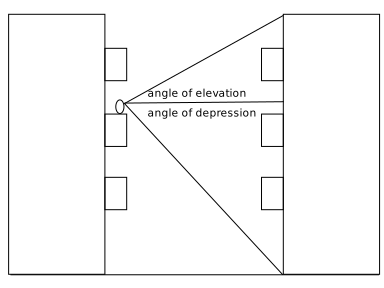
The observer is on a balcony on the second story of a building. There is a horizontal line from the viewer across to the building on the other side of the street. There is another line from the observer to the top of the building across the street. The angle between the horizontal and the view of the top is labeled angle of elevation.
A third line goes from the observer to the bottom of the building across the street. The angle between the horizontal and the bottom of the building is labeled angle of depression.
For all of these applications our first task is to recognize a right triangle in the problem. We must also identify what the two legs and/or the hypotenuse are in the application. Then we can set up an equation using a trigonometric function, and use the equation to calculate something.
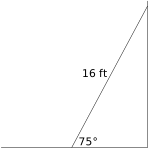
For safety reasons the optimal angle of elevation of a ladder is 75°. If the ladder is 16 ft long, at what height will the top of the ladder be resting against a wall? We can measure a tenth of a foot but not very easily measure a hundredth of a foot, especially for placing a ladder.
First, it is often useful to sketch an image. This makes it easier to identify triangles or other shapes. Note the sketch does not need to be artistic.
We notice that the ladder forms the hypotenuse of a right triangle with the ground and the wall. Next we identify details. We know an angle (75° angle of elevation from the ground) and the length of the hypotenuse (length of the ladder). We want the length of the side opposite the angle (height along the wall). From this information (opposite, hypotenuse, angle) we can recognize the need for the sine function.
Why round to one decimal place? A hundredth of a foot is much less than an inch. This would make no difference in any application. Rounding to the nearest foot (units) would ignore as much as a half foot which could make a difference.
We may also wish to know how far from the wall to place the bottom of the ladder. That is calculating the length of the side adjacent to the angle of elevation, so we use the cosine function.
This is quite close to the previous solution, specifically the difference is too small to effect ladder placement. The difference is the result of using the 15.45 length which was rounded.
We want to determine the height of a tree, but dropping a measuring tape from the top is impractical. Instead we can use its shadow, which being on the ground, is easier to access.
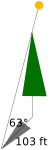
The sun casts a shadow of a tree on the ground. The distance from the top of the shadow to the base of the tree is measured to be 103 ft (this is the length of the shadow). From the end of the shadow the angle of elevation to the sun is measured to be 63°. How tall is the tree? Round using significant digits because this is based on measurements. We do not want to claim a precision about the height which is not valid.
The tree, shadow, and line to the sun form a right triangle with angle 63°, and an adjacent side length of 103 ft. The height of the tree is the length of the opposite leg. Because we know the adjacent and want the opposite we use the tangent function.
Aircraft typically fly a 3° angle of depression to a point 1020 ft past the start of the runway. How high would the plane be when it crosses the runway threshhold? Round to the nearest foot, because aircraft cannot be controlled sufficiently precisely for greater precision to matter here.
It is possible to define the trigonometric functions as ratios of sides, because there is a connection between how big an angle is, and how big the side across from it must be. The following activity illustrates how the three main trigonometric functions change as the angle increases or decreases because of this connection between angle measure and length of sides.
This activity has two steps. First notice the relationship between the how big an angle is and how long the side opposite that angle is. Second notice how the trig functions change as a result of this first fact. Use the activity in Figure 7.1.20
Use the slider for \(\alpha\) to increase the angle from \(0^\circ\) to \(90^\circ\text{.}\) As the angle increases what does the length of the opposite side (j) do?
Use the slider for \(\alpha\) to increase the angle from \(0^\circ\) to \(90^\circ\text{.}\) As the angle increases what does the length of the adjacent side (j) do?
Note that the hypotenuse does not change in this example. Based on your result in Task 14.a, as the angle \(\alpha\) increases what will the ratio of opposite to hypotenuse (j/g) do?
Note that the hypotenuse does not change in this example. Based on your result in Task 14.b, as the angle \(\alpha\) increases what will the ratio of adjacent to hypotenuse (i/g) do?
While angle size and triangle side length is connected, we can always scale a triangle (e.g., make it twice as large) without changing the angles and hence not changing the trig function values. This is why the trig functions are defined as ratios: the scale is divided out.
Another way to look at this is to recall similar triangles (Subsection 2.4.3). The ratios between corresponding sides of two, similar triangles is fixed (all three ratios are the same value). This means ratios of sides of one triangle will be the same as ratios of sides of the other triangle: one will be expressed in non-reduced form. The next examples illustrate this idea.
Consider a right triangle with side lengths 8, 15, and 17. If \(A\) is the angle opposite from the side of length 8, then \(\sin(A)=\frac{8}{17}\text{.}\)
Next consider a right triangle with side lengths 16, 30, and 34. If \(A^\prime\) is the angle across from 16, then \(\sin(A^\prime)=\frac{16}{34}=\frac{8}{17}\text{.}\) This is the same ratio as the previous triangle although the triangle is larger (double in each side length).
Consider the right triangle with side lengths 8, 15, and 17. If we scale this triangle until the side of length 8 is now length 40, what are the other side lengths?
If \(A\) is the angle opposite from the side of length 8 in the original triangle, then \(\sin(A)=\frac{8}{17}\text{.}\) Scaling the triangle does not change the angles, so the new triangle has an angle with the same angle measure as \(A\text{,}\) call it \(A^\prime\text{.}\) Putting these together gives us the following.
The last line is included to show how the hypotenuse is scaled the same way the opposite leg is. We could use tangent to show the other leg is also scaled by 5, that is the adjacent leg will be length \(15 \cdot 5 = 75\text{.}\)
The Pythagorean Theorem tells us that if we know two sides of a right triangle, the length of the third side is already determined. This means there are restrictions on the side lengths from which a right triangle can be assembled.
By calculating the sides of a triangle, we will recognize a limitation on how small a hypotenuse can be relative to either leg. Treat all numbers as exact. Do not round.