
Project 5. Project: Biking in Kansas and Alaska.
In this project, we are going to think about what makes a relationship linear or not linear. Each question is worth two points.
(a)
This is a graph of a linear relationship. Looking at it, what about it tells you that it is linear?
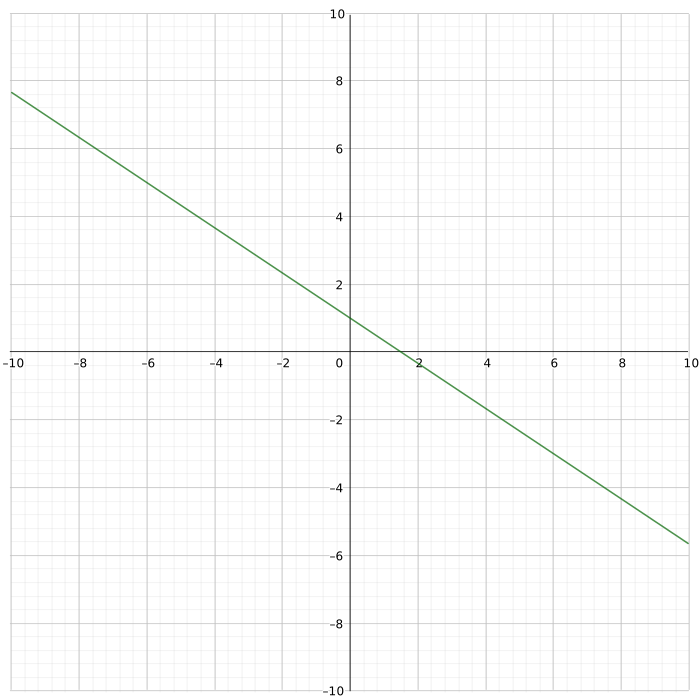
Horizontal and vertical axes are labeled -10 to 10 in increments of 2. There are 4 minor grid lines between each major grid lines. The line begins in the third quadrant (upper left) and works down to the fourth quadrant (bottom right) briefly cutting through the first quadrant (upper right). There are no obvious points.
(b)
Here is a table of some of the points represented on the above graph. This data also represents a linear relationship. Without graphing, how can you tell that this relationship is linear?
(c)
Friends Jacob and Mike like to bike. For a math conference, the two traveled to Kansas and decided to go on a bike ride one evening. Mike enjoys tracking his data and so took note of his distance traveled at regular intervals. Here is a table of Mike’s time and mileage:
Does this table represent a linear relationship? Give some supporting computations OR write a sentence to support your answer.
(d)
Jacob is more absent minded in tracking his mileage over time, and so took note of his distance traveled sporadically. Here is a table of Jacob’s time and mileage:
Does this table represent a linear relationship? Give some supporting computations OR write a sentence to support your answer.
(e)
After returning home to Alaska, the friends decide to go on another ride. This bike ride was on a trail in the foothills of the Chugach Mountains. Again, Mike took note of his distance traveled at regular intervals Here is a table of Mike’s time and mileage:
Does this table represent a linear relationship? Give some supporting computations OR write a sentence to support your answer.
(f)
Again, Jacob is absent minded in tracking his mileage over time, and so took note of his distance traveled sporadically. Here is a table of Jacob’s time and mileage:
Does this table represent a linear relationship? Give some supporting computations OR write a sentence to support your answer.
(g)
Slope is \(\frac{\text{change in y values}}{\text{change in x values}}\text{.}\) If the first columns of the four tables above represent x values and the second columns represent y values, determine the unit of the slope. Your answer should be a unit, like ft⁄s or in2, not a number.
(h)
(1 point extra credit): Consider your answer to the previous question. What does this unit represent? Your answer can be one word.

