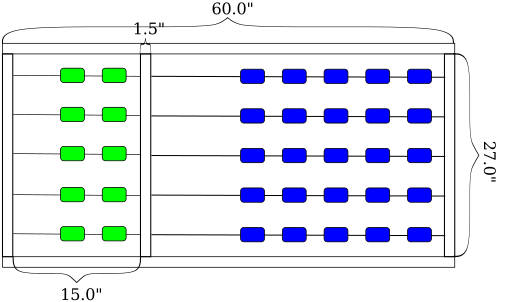
Each board has six surface. Each surface size appears twice (e.g., top and bottom). For the long segments these areas are
\begin{align*}
60\text{ in} \cdot 3.5\text{ in} \amp = 210\text{ in}^2,\\
60\text{ in} \cdot 1.5\text{ in} \amp = 90\text{ in}^2,\\
1.5\text{ in} \cdot 3.5\text{ in} \amp = 5.25\text{ in}^2.
\end{align*}
For the short segments these are
\begin{align*}
27\text{ in} \cdot 3.5\text{ in} \amp = 94.5\text{ in}^2,\\
27\text{ in} \cdot 1.5\text{ in} \amp = 40.5\text{ in}^2,\\
1.5\text{ in} \cdot 3.5\text{ in} \amp = 5.25\text{ in}^2.
\end{align*}
Thus the total area is
\begin{align*}
2(2)(210\text{ in}^2)+2(2)(90\text{ in}^2)+2(2)(5.25\text{ in}^2)\\
+3(2)(94.5\text{ in}^2)+3(2)(40.5\text{ in}^2)+3(2)(5.25\text{ in}^2) \amp = \\
810+360+21+567+246+31.5\text{ in}^2 \amp = 2035.5\text{ in}^2
\end{align*}
Finally we convert this to square feet using the method of
Example 1.1.23.
\begin{align*}
2035.5\text{ in}^2 \cdot \left(\frac{1 \text{ ft}}{12 \text{ in}}\right)^2 & = \\
\frac{2035.5\text{ in}^2}{12^2 \text{ in}^2} \text{ ft}^2 & = \\
\frac{2035.5}{144} \text{ ft}^2 & \approx 14.13541667 \text{ ft}^2.\\
& \approx 15\text{.}
\end{align*}
We round up because we want to be safe and because we likely cannot order an amount to cover exactly 14.1 square feet.