Logo image

Mathematics in Trades and Life

Section 4.2 Geometric Reasoning 3D

This section addresses the following topics.
  • Read and use mathematical models in a technical document
This section covers the following mathematical concepts.
  • Identify shapes and apply their properties (skill)
This section presents geometric properties, illustrates identifying shapes in applications, and illustrates breaking down complex shapes into simple ones.

Subsection 4.2.1 Formulae

This section defines the two properties of interest and provides the formulae for some common shapes. Memorizing all of the formulae is not likely useful: in a job you will be able to look them up. However, anything you use a lot (e.g., prisms and spheres) is worth memorizing.
Use this section to learn to identify which measurement is used in each part of a formula and how to determine those from diagrams or descriptions of shapes. The next section will illustrate using these properties in applications.
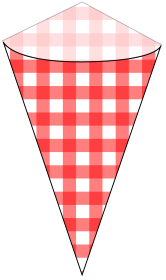
The surface area of a 3D shape is the cummulative area of all the 2D areas of the shape. You can think of it as the amount of paint needed to cover the object. The volume of a 3D shape is a measure of what it takes to fill a 3D shape. In the figure below showing a paper cone for holding popcorn, the surface area is the amount of wax needed to coat the inside of the cone so the popcorn (butter) does not soak through the paper. The volume is how much popcorn can be held.
Roughly conical shape made from checkered paper
Figure 4.2.1. Complex Shape with Surface and Volume

Rounding.

How we round on geometric problems will depend as always on the application. For example a carpenter will round to units that can be measured with a tape measure like 1/16 of an inch. Contextless examples in this section will be rounded using significant digits. When using significant digits treat all numbers in the formulae as exact numbers.

Definition 4.2.2. Prism.

A prism is a solid consisting of two identical polygons connected by parallelograms.
These look like a polygon has been extruded. That polygon is called the base. If the base is extruded perpendicular to its surface, then it is called a right prism. Typically this means the sides are rectangles.
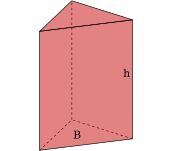
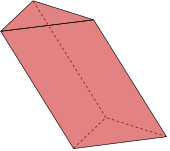
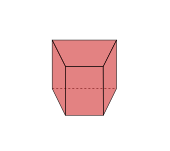
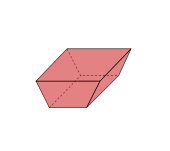
Prisms are named for their base shape. For example, there are triangular prisms and pentagonal prisms. The figure below shows four prisms. Those on the left are right prisms, and those on the right are skewed. The top two are triangular prisms, and the bottom two are trapezoidal prisms.
Right triangular prism built from a right triangle
Skewed triangular prism built from a right triangle
Right rectangular prism built by extruding a rectangle backwards
Skewed trapezoidal prism
Figure 4.2.3. Various Prisms
Table 4.2.4. Prisms
Shape
Surface Area
Volume
sum of area of all sides
\(V = B h\)
For surface area the sides are always parallelograms (rectangles for right prisms). For the volume \(B\) is the area of the base (the triangle or trapezoid in the four examples). \(h\) is the height or distance from the bottom to the top (or front to back if we tip the prism over). Note this is not along an edge, but perpendicular to the base.

Example 4.2.5.

(a)
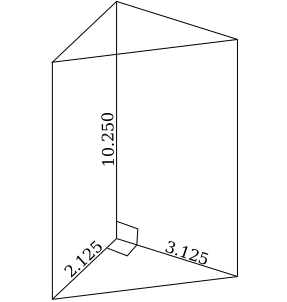
What is the surface area of the right triangular prism in FigureΒ 4.2.6?
The surface area consists of the areas of the two right triangles and the three rectangles. Because the triangles are right triangles, they both have area \(\frac{1}{2} \cdot 2.12\underline{5} \cdot 3.12\underline{5} = 3.3\underline{2}03125\text{.}\) The rectangle areas are \(2.12\underline{5} \cdot 10.25\underline{0} = 21.7\underline{8}125\) and \(3.12\underline{5} \cdot 10.25\underline{0} = 32.0\underline{3}125\text{.}\) For the third rectangle we need to calculate the side length. Because this is a right triangle we can use the Pythagorean theorem.
\begin{align*} (2.12\underline{5})^2+(3.12\underline{5})^2 & = c^2.\\ 4.51\underline{5}625+9.76\underline{5}625 & = c^2. & & \text{ Squaring maintains 4 sigfigs}\\ 14.28\underline{1}25 & = c^2. & & \text{ Adding precise to 1000ths}\\ \sqrt{14.28\underline{1}25} & = c. & & \text{ Root maintains 5 sigfigs}\\ 3.779\underline{0}5 & \approx c.\\ 3.7791 & \approx c. \end{align*}
The third rectangle has area \(3.779\underline{0}5 \cdot 10.25\underline{0} \approx 38.73\underline{5}2625\text{.}\) The total area is
\begin{align*} 2(3.3\underline{2}03125)+21.7\underline{8}125+32.0\underline{3}125+38.73\underline{5}2625 \amp \approx 99.1\underline{8}83875\\ \amp \approx 99.19\text{.} \end{align*}
(b)
What is the volume of the triangular prism in FigureΒ 4.2.6.(a)?
The volume is the area of the triangle, 3.320, times the height of the prism, 10.250. Thus the area is \(3.320 \cdot 10.250 = 34.03\text{.}\)
(c)
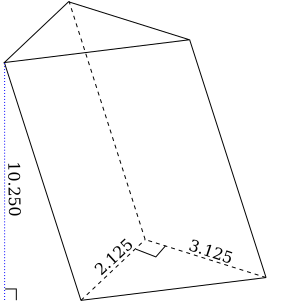
What is the volume of the triangular prism in FigureΒ 4.2.6.(b)?
The volume is the area of the triangle, 3.320, times the height of the prism, 10.250. Thus the area is \(3.320 \cdot 10.250 = 34.03\text{.}\) Notice that the volume is not affected by the tilt of the prism. This is not true of the surface area which we do not have sufficient information to calculate here.
Right triangular prism with sides lengths labeled
The base is a right triangle with leg lengths 2.125 and 3.125. It is a right prism with height 10.250.
(a) Right Triangular Prism
Skewed triangular prism with the same measurements
The base is a right triangle with leg lengths 2.125 and 3.125. It is a skewed prism with height 10.250.
(b) Non-Right Triangular Prism
Figure 4.2.6. Calculate the surface area and volume
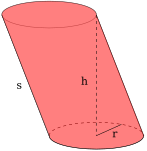
Table 4.2.8. Cylinder
Shape
Lateral Surface Area
Volume
\(A=2\pi r \cdot s\) \(V = \pi r^2 h\)
The height (\(h\)) of the cylinder is the distance from the top disc down to the plane in which the bottom disc sits. It does not necessarily touch both discs (cylinder skewed so far the discs do not overlap). If the cylinder is not slanted then \(s=h\text{.}\) Notice the volume is not dependent on the angle of slant but the lateral surface area is. To obtain the complete surface area add the area of the top and bottom discs to the lateral surface area.
The formula for the area of the side of a cylinder looks like width (\(2\pi r\)) times height (\(s\)) which is the formula for area of a rectangle. Indeed if you think about a can (the type that contain paint, soup, or other substances), the label if peeled off is a rectangle. The height of that rectangle is the height of the can and the width of that rectangle is enough to wrap around the can.

Example 4.2.9.

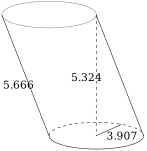
What are the total surface area and volume of this slanted cylinder?
Skewed cylinder with raidus 3.907, height 5.324, and slant height 5.666
The lateral surface area is
\begin{align*} 2\pi(3.90\underline{7})(5.66\underline{6}) & \approx \\ 2(3.1415\underline{9})(3.90\underline{7})(5.66\underline{6}) & \approx 139.\underline{0}911452. \end{align*}
We must approximate \(\pi\) precise to at least as many positions as the rest of the numbers. Otherwise we will decrease the overall precision. We do not need to use more positions: the extra disappears in the rounding at the end. Here we use the portion most commonly memorized or listed in a table.
The area of the top and bottom are both
\begin{align*} \pi(3.90\underline{7})^2 & \approx \\ (3.1415\underline{9})(3.90\underline{7})^2 & \approx 47.9\underline{5}526865. \end{align*}
Thus the total surface area is
\begin{equation*} 2(47.9\underline{5}526865)+139.\underline{0}911452 \approx 235.\underline{0}016825 \approx 235.0. \end{equation*}
The volume is
\begin{align*} V & = \pi(3.90\underline{7})^2(5.32\underline{4})\\ & \approx (3.1415\underline{9})(3.90\underline{7})^2(5.32\underline{4})\\ & \approx 255.\underline{3}138503\\ & \approx 255.3 \end{align*}
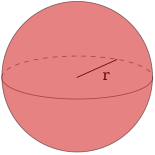
Table 4.2.10. Sphere
Shape
Surface Area
Volume
\(A=4\pi r^2\) \(V = \frac{4}{3}\pi r^3 \)
The 4 and 4/3 are exact numbers.

Example 4.2.11.

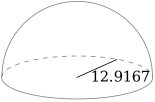
What are the surface area and volume of this spherical dome? The dome is sitting on the ground so the only surface area of importance is the top surface.
Top half of a sphere with radius 12.9167
Because this is a dome (half sphere) we divide the formula by 2.
\begin{align*} A & = \frac{1}{2}(4\pi(12.9167)^2) \text{ Squaring maintains 6 sigfigs}\\ & \approx \frac{1}{2}(4(3.14159)(12.9167)^2) \text{ Approximate to 6 sigfigs}\\ & \approx 1048.2\underline{9}2907 \text{ Product maintains 6 sigfigs}\\ & \approx 1048.29 \end{align*}
\begin{align*} V & = \frac{1}{2}\left(\frac{4}{3}\pi(12.9167)^3 \right)\\ & \approx \frac{1}{2}\left(\frac{4}{3}(3.14159)(12.9167)^3 \right)\\ & \approx 4513.4\underline{9}4997\\ & \approx 4513.49 \end{align*}
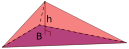
Table 4.2.12. Pyramid
Shape
Surface Area
Volume
sum of surfaces
\(V = \frac{1}{3} B h \)

Example 4.2.13.

(a)
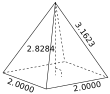
What is the surface area of this pyramid?
Pyramid with square base with side length 2.0000, height 2.8284, and slant height 3.1623
This pyramid consists of four, identical triangular sides and a square base. Note the side lengths are given as exact numbers.
The area of one of the triangles can be found using Heron’s formula.
\begin{align*} s & = \frac{1}{2}(2.0000+3.1623+3.1623)\\ & = 4.1623. \text{ All numbers precise to 4 decimal places}. \\ A & = \sqrt{s(s-3.1623)(s-3.1623)(s-2.0000)}\\ \end{align*}
Subtraction maintains 4 decimal places
\begin{align*} & = \sqrt{(4.1623)(1.0000)(1.0000)(2.1623)} \text{ Product will have 5 sigfigs}\\ & = \sqrt{9.000\underline{1}4129} \text{ Root will maintain 5 sigfigs}\\ & = 3.000\underline{0}23548\\ & = 3.0000. \end{align*}
The area of the base is \(2.0000 \cdot 2.0000 = 4.0000\text{.}\) Thus the surface area is \(4.0000+4(3.0000)=16.0000\text{.}\)
(b)
What is the volume of this pyramid?
The volume is \(V=\frac{1}{3}(2.0000^2)(2.8284) = 3.7712\text{.}\)

Example 4.2.14.

Calculate the volume of this rectangular pyramid.
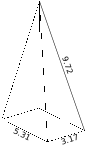
Pyramid with rectangular base with side lengths 5.31 and 3.17 and slant height 9.72
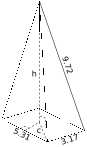
To calculate the volume we need the height which is not labeled. This is probably because we cannot put a measuring tape along the height (interior). However, we can calculate the height based on the right triangle with the height as one leg and the edge length as the hypotenuse. The second leg is in the base from the center to the corner of the pyramid.
We do not have the length of the segment on the base (center to corner). If we add a line from the center of the base to the midpoint of one of the sides, we form another right triangle with the desired length as the hypotenuse. The legs are each half the length of one of the sides. The Pythagorean theorem will give us the hypotenuse length.
The same diagram as above but with two right triangles described above labeled
\begin{align*} \left(\frac{5.31}{2}\right)^2+\left(\frac{3.17}{2}\right)^2 & = c^2.\\ 7.0\underline{4}9025+2.5\underline{1}2225 & = c^2. & & \text{ Square maintains 3 sigfigs}\\ 9.5\underline{6}125 & = c^2. & & \text{ Addition maintains precision to 2 places}\\ \sqrt{9.5\underline{6}125} & = c. & & \text{ Root maintains 3 sigfigs}\\ 3.0\underline{9}21271 & \approx c.\\ 3.09 & \approx c. \end{align*}
Next, we can use this length and the given side length to calculate the height.
\begin{align*} 3.0\underline{9}21271^2 + h^2 & = 9.72^2.\\ 9.5\underline{6}125 + h^2 & = 94.\underline{4}784. & & \text{ Square maintains 3 sigfigs}\\ h^2 & = 94.\underline{4}784-9.5\underline{6}125. \\ h^2 & = 84.\underline{9}1715.\\ \end{align*}
Subtraction maintains precision to only one place
\begin{align*} h & = \sqrt{84.\underline{9}1715}. & & \text{ Root maintains 3 sigfigs}\\ h & \approx 9.2\underline{1}505019\\ h & \approx 9.22. \end{align*}
Finally we can calculate the volume. The base has area \(5.31 \cdot 3.17 = 16.\underline{8}327 \approx 16.8\text{.}\) This pyramid has volume
\begin{equation*} V = \frac{1}{3}(16.\underline{8}327)(9.2\underline{1}505019) \approx 51.\underline{7}0472510 \approx 51.7\text{.} \end{equation*}

Checkpoint 4.2.16.

What is the relationship between the volume of a pyramid to the volume of a prism with the same base? β€œsame base” means the same shape and size. The pyramid could then be placed inside the prism.
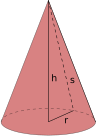
Table 4.2.17. Cone
Shape
Lateral Surface Area
Volume
\(A=\pi r \sqrt{h^2+r^2}\) or \(A=\pi r s\) \(V = \frac{\pi}{3} r^2 h \)
The surface area formulas apply only when it is a right circular cone (tip of the cone directly above the center of the circle). For the full surface area we add the area of the circle at the bottom of the cone. The volume formula works for all cones.

Example 4.2.18.

Calculate the total surface area and the volume of this cone.
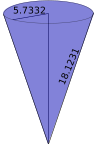
Right cone with point downward having radius 5.7332 and slant height 18.1231
The surface area can be calculated directly. The lateral surface area is
\begin{align*} LA & = \pi r s\\ & \approx (3.14159)(5.7332)(18.1231) \text{ Minimum 5 sigfigs}\\ & \approx 326.4\underline{2}17471\\ & \approx 326.42 \end{align*}
The area of the top circle is
\begin{align*} TA & = \pi r^2\\ & \approx (3.14159)(5.7332)^2 \text{ Minimum 5 sigfigs}\\ & \approx 103.2\underline{6}27509\\ & \approx 103.26 \end{align*}
The total area therefore is \(A = 326.4\underline{2}17471+103.2\underline{6}27509 \approx 429.6\underline{8}44980 \approx 429.68\text{.}\)
To calculate the volume we need to first calculate the height. Looking at the image we see that the labeled radius and side length are part of a right triangle with the height. This means
\begin{align*} h^2+5.7332^2 & = 18.1231^2 \text{ Squaring maintains sigfigs}\\ h^2 + 32.86\underline{9}5224 & \approx 328.44\underline{6}7536 \text{ Precise to 3 places}\\ h^2 & \approx 328.44\underline{6}7536 - 32.86\underline{9}5224\\ h^2 & \approx 295.57\underline{7}1714\\ h & \approx 17.192\underline{3}5794 \text{ Root preserves 6 sigfigs}\\ & \approx 17.1924. \end{align*}
Having calculated the height we can calculate the volume
\begin{align*} V & = \frac{\pi}{3}r^2 h\\ & \approx \frac{3.14159}{3}(5.7332)^2(17.192\underline{3}5794)\\ & \approx 591.7\underline{7}67250\\ & \approx 591.78 \end{align*}
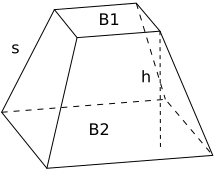
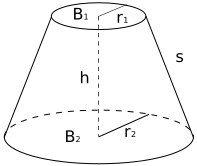
The frustums are compound shapes: they are obtained by subtracting one shape from itself. The latin word frustum means β€œcut off.” This is the etymology of β€œfrustrated” which refers to a cut off hope. For these formulae the bases must be parallel. Note \(P_i\) below refers to the perimeter of the bases.
Table 4.2.19. frustum of a Pyramid
Shape
Lateral Surface Area
Volume
\(\frac{1}{2}s(P_1+P_2)\) \(V = \frac{1}{3} h (B_1+B_2+\sqrt{B_1 B_2}) \)
\(P_1\) is the perimeter of the lower base (bottom polygon). It will be the sum of the lengths of each side. \(P_2\) is calculated similarly for the upper base (top polygon). \(B_1\) is the area of the lower base (bottom polygon). It will be calculated based on the type of polygon (e.g., area of a triangle, parallelogram, etc.). \(B_2\) is the area of the upper base.

Example 4.2.20.

(a)
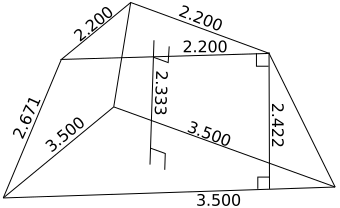
What is the surface area of the frustum of the pyramid in FigureΒ 4.2.21?
The surface area consists of the areas of the base and top which are triangles and the three sides which are rhobmi. For the base and top we know the lengths of the three sides, so we can use Heron’s formula to calculate their areas. The perimeter of the lower base (triangle) is \(3(3.500)=10.500\) (The number of sides, 3, is an exact number so precision is not changed.) The perimeter of the upper base (triangle) is \(3(2.200)=6.600\text{.}\)
\begin{align*} s_1 & = 10.500.\\ A_1 & = \sqrt{10.500(10.500-3.500)^3}\\ & = \sqrt{10.500(7.000)^3}\\ & = \sqrt{360\underline{1}.5}\\ & \approx 60.0\underline{1}24987\\ & \approx 60.01.\\ s_2 & = 6.600.\\ A_2 & = \sqrt{6.600(6.600-2.200)^3}\\ & = \sqrt{6.600(4.400)^3}\\ & = \sqrt{562.\underline{2}144}\\ & \approx 23.7\underline{1}106071\\ & \approx 23.71. \end{align*}
The three sides are rhombi. The area of one of them is
\begin{align*} A & = \frac{1}{2}(2.422)(3.500+2.200)\\ & = \frac{1}{2}(2.422)(5.700) \text{ Remains precise to 3 places}\\ & = 6.90\underline{2}7 \text{ Maintains 4 sigfigs}\\ & \approx 6.903. \end{align*}
Thus the surface area of the entire shape is \(60.0\underline{1}24987+23.7\underline{1}106071+3(6.90\underline{2}7) \approx 104.4\underline{3}16594 \approx 104.43\text{.}\)
(b)
What is the volume of the frustum of a pyramid in FigureΒ 4.2.21?
We need the height (labeled) and the area of the two bases which were calculated in the previous step. Using these values
\begin{align*} V & = \frac{1}{3}(2.333)(60.01+23.71+\sqrt{(60.01)(23.71)}) \text{ Product maintains 4 sigfigs}\\ & = \frac{1}{3}(2.333)(60.01+23.71+\sqrt{142\underline{2}.8371}) \text{ Root maintains 4 sigfigs}\\ & = \frac{1}{3}(2.333)(60.01+23.71+37.7\underline{2}051299) \text{ All terms precise to 2 places}\\ & = \frac{1}{3}(2.333)(121.4\underline{4}0513) \text{ Product maintains 4 sigfigs}\\ & = 94.4\underline{4}023895\\ & \approx 94.44. \end{align*}
frustum of a right, triangluar pyrmaid with lengths labeled
Figure 4.2.21. Calculate Area and Volume of this frustum
Table 4.2.22. frustum of a Cone
Shape
Lateral Surface Area
Volume
\(\pi s(r_1+r_2)\) \(V = \frac{1}{3} h (B_1+B_2+\sqrt{B_1 B_2}) \)
The total surface area adds the area of the two discs (bottom and top) to the lateral surface area. The volume is the same formula as for a frustum of a pyramid because these are pyramids built on a circle.

Example 4.2.23.

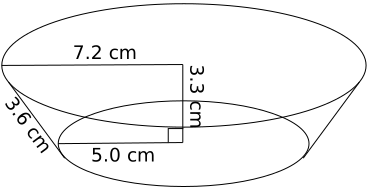
What is the surface area an volume of one part of a muffin tin? The surface area would be the area of a paper liner (assuming it is flat and not corrugated) and the volume is the amount of batter that can be held (if fully filled).
frustum of a cone with radii 7.2 and 5.0, height 3.3, and slant height 3.6
The surface area will be the lateral surface area plus the area of the bottom base (muffin tin is open on top).
\begin{align*} LA & = \pi s(r_1+r_2)\\ & \approx (3.14159)(3.6)(5.0+7.2) \text{ Sum maintains 1 place precision}\\ & \approx (3.14159)(3.6)(12.2) \text{ Product maintains 2 sigfigs}\\ & \approx 1\underline{3}7.9786328\\ & \approx 140.\\ BA & = \pi r^2\\ & \approx (3.14159)(5.0)^2\\ & \approx 7\underline{8}.53975\\ & \approx 79. \end{align*}
The total surface area is \(1\underline{3}7.9786328+7\underline{8}.53975 \approx 2\underline{1}6.5183828 \approx 220\) cm squared.
The volume requires calculating the area of the top surface as well.
\begin{align*} TA & = \pi r^2\\ & \approx (3.14159)(7.2)^2\\ & \approx 1\underline{6}2.8600256\\ & \approx 160. \end{align*}
Now we can calculate the volume of the muffin tin.
\begin{align*} V & = \frac{1}{3}\left(3.3)(78+160+\sqrt{(78)(160)}\right) \text{ Product maintains 2 sigfigs}\\ & = \frac{1}{3}(3.3)\left(78+160+\sqrt{1\underline{2}480}\right) \text{ Root maintains 2 sigfigs}\\ & \approx \frac{1}{3}(3.3)(78+160+1\underline{1}1.7139) \text{ Root maintains 2 sigfigs}\\ & \approx \frac{1}{3}(3.3)(3\underline{4}9.7139) \text{ Product maintains 2 sigfigs}\\ & = 3\underline{8}4.6853\\ & = 380 \end{align*}
The volume is 380 square centimeters.
If we have the slant height (length of the side of a frustum of a cone) we can calculate the height. This is similar to the calculation of height in ExampleΒ 4.2.14.

Example 4.2.24.

Suppose the larger radius is 7.32, the smaller radius is 5.44, and the slant height is 6.09. The slant height is the hypotenuse of a right triangle with the height being one other side. The third side is on the larger base and has length \(7.32-5.44=1.88\text{.}\) We can use the Pythagorean theorem to calculate the height.
\begin{align*} h^2+1.88^2 & = 6.09^2. \text{ Square maintains 3 sigfigs}\\ h^2+3.5\underline{3}44 & = 37.\underline{0}881.\\ h^2 & = 37.\underline{0}881-3.5\underline{3}44. \text{ Subtraction precise to 1 place}\\ h^2 & = 33.\underline{5}537.\\ h & = \sqrt{33.\underline{5}537} \text{ Root maintains 3 sigfigs}\\ & \approx 5.7\underline{9}255567\\ & \approx 5.79. \end{align*}

Checkpoint 4.2.25.

For the surface area of a frustum of a cone we use the slant height: the distance from the edge of the bottom base to the edge of the top base. Here we consider limitations on that length.
For these questions suppose the bottom base has radius 5. The top base will vary depending on the slant height.
(b)
What is the bottom of the range of possible slant heights for this frustum?
(c)
If the height is 3 and the top base has radius 1, what is the slant height?
(d)
If the height is 3 and the top base has radius 0.5, what is the slant height?
(e)
What is the top of the range of possible slant heights for this frustum? Note this is for bottom base radius 5, height 3, and top base radius unrestricted (but smaller than bottom base).

Subsection 4.2.2 Applying Geometry

Effectively using knowledge of geometric properties requires recognizing the shapes we know in problems we encounter and figuring out missing parameters from the parameters we do know. The latter we did in ExampleΒ 4.2.14 and ExampleΒ 4.2.24. We will extend our ability to calculate missing parameters in ChapterΒ 7. In the following problems we identify shapes and apply the appropriate formulae.

Example 4.2.26.

What is the total, external area of this birdhouse? All measurments are in inches and accurate to 1/8 inch.
Birdhouse that is an A frame: trianglular prism with hole in the front
First, we identify the shapes. The front and back are triangles. The front triangle has a circular hole in it. The bottom and two sides are rectangles. Although this is a 3D object surface area uses 2D formulae.
For the triangles, we have edge lengths and not the height, because it is easier to measure the edges than the middle. For the area we will use Heron’s formula.
\begin{align*} s & = \frac{1}{2}(5+5+3)\\ & = \frac{13}{2}\\ & = 6.5\\ TA & = \sqrt{\left(6.5\right)\left(6.5-3\right)\left(6.5-5\right)^2}\\ & = \sqrt{\left(6.5\right)\left(3.5\right)\left(1.5\right)^2}\\ & = \sqrt{51.1875}\\ & \approx 7.1545 \end{align*}
For the hole we know the diameter so we use the area formula \(\frac{\pi}{4}d^2\text{.}\) This hole has area
\begin{equation*} \frac{\pi}{4}(1)^2 \approx \frac{3.14159}{4} \approx 0.7853975 \end{equation*}
The area of the front triangle is \(7.1545-0.7853975 \approx 6.3691025\text{.}\)
The bottom rectangle has area \(3 \cdot 10 = 30\) square inches. The two sides both have area \(5 \cdot 10 = 50\) square inches.
Thus the total area is
\begin{equation*} 7.1545+6.3396025+2(50)+30 \approx 143.5236025 \approx 143.6\text{.} \end{equation*}
We round up because this is the safer estimate (better to have a little more than not enough for construction).

Example 4.2.27.

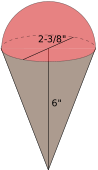
An ice cream cone has the dimensions shown below.
Conical ice cream cone with hemisphere on the top.
(a)
What is the volume of the ice cream? No person can scoop with sufficient accuracy for a fraction of a square or cubic inch, so we will round to units.
Solution.
First, we identify the shapes. This is a right circular cone with a half sphere on top. The diameter of the cone and sphere is \(2 \; \frac{3}{8} = 2.375\) inches. The radius then is half of that or \(1 \; \frac{3}{16} = 1.1875\text{.}\) We convert to decimal inches, because in the end we would want to convert cubic inches (volume) to cups or pints or similar volume measures. This is easier with decimal inches.
The volume of the cone is
\begin{align*} V_c & = \frac{\pi}{3} (1.1875)^2 (7)\\ & \approx \frac{3.14159}{3} (1.1875)^2 (7)\\ & \approx 10.33697647\text{.} \end{align*}
The volume of the half sphere is
\begin{align*} V_s & = \frac{1}{2} \cdot \frac{4}{3} \pi (1.1875)^3\\ & \approx \frac{2}{3}(3.14159)(1.1875)^3\\ & \approx 3.507188445\text{.} \end{align*}
Thus the total volume of the ice cream is \(10.33697647+3.507188445 \approx 13.84416492 \approx 14\) cubic inches.
(b)
What is the surface area of the ice cream? Note the greater the area the faster it melts.
Solution.
This is a right circular cone with a half sphere on top. The surface area of the cone is
\begin{align*} A_c & = \pi(1.1875)\sqrt{6^2+(1.1875)^2}\\ & \approx (3.14159)(1.1875)\sqrt{6^2+(1.1875)^2}\\ & \approx (3.14159)(1.1875)\sqrt{37.410156}\\ & \approx (3.14159) (1.1875) (6.116384)\\ & \approx 22.81801626\text{.} \end{align*}
The surface area of the half sphere is \(\frac{1}{2} \cdot 4 \pi (1.1875)^2 \approx 8.860265547\text{.}\) Thus the total surface area of the ice cream is \(22.81801626+8.860265547 \approx 31.67828181 \approx 32\) square inches.

Example 4.2.28.

A part is produced by drilling a cylindrical hole into a cylinder as shown below. If the weight of aluminum is \(2.70 \text{g}/\text{cm}^3\) what is the total weight of this part? These are precision measurements; round using significant digits.
Right circular cylinder with smaller right circular cylinder cut out of it
First, we calculate the volume of the cylinder. It has a radius of \(1.20/2=0.60 \text{ cm}\text{.}\) The volume is
\begin{align*} V_C & = \pi(0.60 \text{ cm})^2(5.00 \text{ cm})\\ & \approx 3.14159(0.60 \text{ cm})^2(5.00 \text{ cm})\\ & \approx 5.654862 \text{ cm}^3\\ & \approx 5.7 \text{ cm}^3\text{.} \end{align*}
Next, we need to calculate the volume of the hole that is drilled out. That radius is given in mm, so we should convert to cm first. 4.76 mm is 0.476 cm, because there are 10 millimeters per centimeter. It has a radius of \(0.476/2=0.238 \text{ cm}\text{.}\) The volume is

\begin{align*} V_C & = \pi(0.238 \text{ cm})^2(4.00 \text{ cm})\\ & \approx 3.14159(0.238 \text{ cm})^2(4.00 \text{ cm})\\ & \approx 0.7118088958 \text{ cm}^3\\ & \approx 0.712 \text{ cm}^3\text{.} \end{align*}
The total volum is \(5.654862-0.7118088958 \approx 4.943053104 \approx 4.9\text{.}\)
Finally, we can convert the volume to weight. The units suggest we can multiply,
\begin{equation*} 4.943053104 \text{ cm}^3 \cdot \frac{2.70 \text{ g}}{\text{cm}^3} \approx 13.34624338 \text{ g} \approx 13 \text{ g}\text{.} \end{equation*}

Exercises 4.2.3 Exercises

Practice Formulae.

Use the appropriate formulae to calculate requested values.

Compound Shapes.

Identify the shapes from which each object is formed and use appropriate formulae to calculate the property requested.

Geometry in Applications.

Identify shapes and use appropriate formulae to calculate the results requested.

Quantitative Literacy.

Use your understanding of geometry to address these questions.