This section presents algebra needed to work with models involving more complex, rational (fractional) expressions; and it presents how to answer questions requiring adding rates.
In previous sections many of the models involving rational (fractional) expressions could be set up so we solved for a variable in the numerator. In this section we look at multiple examples in which we must solve for a variable in the denominator.
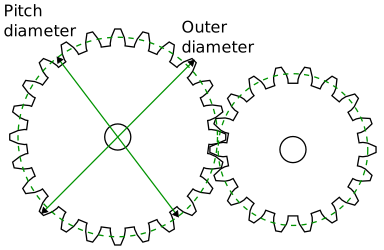
Outer diameter is labeled as the length of a line going from the tip of one gear tooth to the tip of the gear tooth diametrically opposed. Pitch diameter is labeled as the length of a diameter of a circle drawn roughly half way between bottom and top of the gear teeth. That circle is rubbing against the matching circle of the second gear (as if these were toothless wheels).
Outer diameter is the diameter of a circle that contains the tips of the teeth. Pitch diameter is the diameter of a circle such that this gear touches the other gear at this distance. It is illustrated as the dashed circles in the figure above.
Suppose we know the outer diameter (17/8") and pitch diameter (2") needed for a gear. What are the steps to solve for the number of teeth? The number of teeth must end up an integer (half a gear tooth is just a broken gear). Thus there will be no rounding. If the calculation gives a non-integer result, we must change something in the design.
Suppose the conditions for a tire are \(P_1=3\bar{0}\) psi at a temperature of \(T=52^\circ\) F. At what temperature will the pressure drop below the safe value of 28 psi? Because our gauges are not more accurate we will round to units.
Some rational expressions have the variable in both numerator and denominator. These are handled exactly the same: we can still multiply to eliminate the fractions.
The final example in this section presents a type of problem involving adding multiple fractions. This is needed for the resistors in parallel problem and is connected to the next section on additive rates.
From the positive side of the battery the circuit continues and then splits into a Y. On each branch of the Y is a resitor. From the farther side of both resitors the circuit continues and comes back together (reverse Y). From here the circuit returns to the negative side of the battery.
Note the need for a common denominator in the third line. The final step is our now frequently used clearing of denominators (i.e., ‘cross multiplication’).
In the previous example we knew the two resistors and calculated the resulting resistance. In other cases we know how much resistance we need and one of the resistors. We must calculate the resistance for the other resistor.
If we need a 5 Ohm resistance and have an 8 Ohm resistor already, what do we add as the second resistor? Resistor measurements are commonly accurate to ±5%. For this problem that allows us to round to units. This is because 5% of 5 is much less than one.
There are many times when we need to calculate the rate at which something can be accomplished when more than one person/thing is working on it. This section illustrates how to obtain a resulting rate from the individual rates. This process requires algebra similar to that above.
A company has two pumps available for draining flooded basements. One pump can drain a basement in 4 hours, whereas the other pump can do the job in only 3 hours. How long would it take to drain the basement if both pumps are used simulataneously?
The question is how to calculate the speed of the combined pumps. Adding a pump should increase the speed. Thus we want to determine a way to add the speeds. We can start by writing down the rates to see what that suggests. The first pump operates at a rate of \(\frac{1 \text{ basement}}{4 \text{ hours}}\) and the second pump operates at a rate of \(\frac{1 \text{ basement}}{3 \text{ hours}}\text{.}\) Because rates are ratios (fractions), and the units match, we know how to add them. The combined rate is
Given this is in hours it makes sense to round to the hundredths (a little less than a minute). It also makes sense to round up (better to expect the worst and be happy it was better). We expect the two pumps to complete the work in 1.72 hours (a little less than 1 hour and 45 minutes).
Because the denominator was 1 basement, when we cleared the denominator (cross multiplication) all we did was adjust the units (basement/basement divides out). This suggests we could have simply scaled the combined rate to obtain the final result.
The increase in speed results in less time required to complete the job. This is why the faster rate (1 basement per 1.72 hours) has a smaller denominator (1.72 vs 3 or 4).
If one housekeeper can clean a hotel room in 11 minutes, and another can clean a room in 13 minutes. How long will it take them combined to clean 27 rooms?
Because the question asks us to determine combined speed, we recognize this as a “joint work” problem. Looking at Example 3.5.17 we see that the first step was to write down the two rates. \(\frac{1 \text{ room}}{11 \text{ minutes}}\) and \(\frac{1 \text{ room}}{13 \text{ minutes}}\text{.}\)