We have learned how to identify exponential data (Section 3.4) and have learned to work with some exponential applications (Section 6.1). This section presents the graph (shape) of exponentials and emphasizes two traits of exponential models.
Because devices can quickly produce accurate graphs for us, it is not the goal of this section to help you become proficiant at sketching graphs. Rather, it is the goal for you to be able to read a model, and recognize what different parts of the model imply, because you know what it would look like.
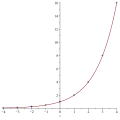
Starting at \(x=0\) consider the curve as it extends to the right. We can use the analogy of walking up hill to understand this curve. At \(x=0\) we are walking up hill so we are a little slower than on a flat surface. At \(x=1\) the height has doubled but so also has the slope (remember the differences are a multiple of the height). Walking the next segment will be more strenuous. At \(x=2\) the height has doubled again, so also has the steepness. Now it is too steep to walk. We will need to scramble or use climbing equipment. Generally an exponential curve becomes increasingly steep.
Because the base of this exponential is 2 (i.e., \(y=2^x\)) each time we move one unit to the right the height doubles (times 2). The easiest place to see this is from \(x=0\) to \(x=1\text{.}\) This is because \(y=2^0=1\) and this is true of any base (i.e., \(y=a^0=1\) for all bases). That means at \(x=1\) the y value will be the base (e.g., \(y=2^1=2\)).
Starting back at \(x=0\) again consider the curve as it extends to the left. We can see that we are walking downhill; we might pick up a little speed. At \(x=-1\) it continues downhill to the left but it is not enough to help us maintain a faster speed. At \(x=-2\) we can no longer see the downhill (too gentle) though we would notice it if we were on a bike or skateboard. Just as the curve becomes twice as high and also twice as steep as we move the to right, it becomes half as high and half as steep as we go to the left. The inability to “see” the downhill nature illustrates that the exponential to the left begins to look like a horizontal line.
Let’s clarify that last statement. We notice that all values (left and right) are positive. So to the left the curve is going down, but it never crosses zero. It must therefore become increasingly close to zero. This is why it begins to look like a line namely \(x=0\text{.}\) When one curve becomes increasingly like another we call that second curve (the line \(x=0\) in this case) an asymptote.
We notice that the amount of bacteria decreases. More specifically we see that it is divided in half each time. This is just the reverse of it doubling each time as it grows.
We also notice that because each previous entry is half of the next, there is always some left. No matter how far back in time we go, there will always be some. This is part of all exponentials: rapid growth in one direction and an increasingly gentle decrease toward some amount (zero in this case) in the other direction.
Not all exponential curves increase to the right and decrease to the left. Some reverse (mirror) this pattern. The following example uses radioactive decay as an example of this.
At time 0 we have \(13\bar{0}\) g. At time 16.8 it will be half of the original which is \(65.0\) g. The 1/2 is an exact number so 3 significant digits is maintained. At time 33.6 it will be reduced by half again (\(33.6 = 18.8 \cdot 2\text{,}\) 2nd half-life). Thus there will be \(\frac{65.0}{2} = 32.5\) g. At time 50.4 it will be reduced by half a third time (\(50.4 = 16.8 \cdot 3\)), so the amount remaining will be \(\frac{32.5}{2} = 16.25 \approx 16.3\) g.
We can use the process from Subsection 6.1.2. The time in minutes is divided by the half-life 16.8 minutes. Because this is reducing by half the scale is \(\frac{1}{2}\text{.}\)
\begin{equation*}
A = 13\bar{0}\left(\frac{1}{2}\right)^{t/16.8}
\end{equation*}
The horizontal axis is labeled minutes and ranges from 0 to 168 in intervals of 16.8. The vertical axis is labeled grams and ranges from 0 to 130. Rather than being evently spaced tick marks on the vertical are double the value of the previous one starting at 8.125. The curve begins at the top left and continues down to the right leveling off above 0.
Notice the gentle decrease toward zero is to the right this time as opposed to the left in Example 6.2.1. That is because we are cutting in half each time instead of doubling.
In Section 5.4 we learned how to shift and stretch parabolas (graphs of quadratics). Those same transformations work on exponentials (and any other function). The following examples illustrate that the effects are the same.
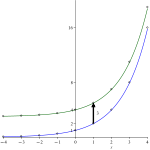
We can begin with \(x=1\text{,}\) from the table we know that \(2^1=2\text{,}\) so for this function we end up with \(2^1+3 = 2 + 3 = 5\text{.}\) On this function the point (1,2) moved to (1,5). We should check another point. Consider \(x=2\text{.}\) From the table we know that \(2^2=4\text{,}\) so for this function we end up with \(2^2+3 = 4+3 = 7\text{.}\)
Notice that every point is 3 units higher than the point in the original graph. We have moved the graph 3 units up. Because the graph has been shifted up 3 units, the asymptote has also been shifted up three units. It is now \(y=3\text{.}\)
Because the asymptote was shifted up, we must measure the doubling from one point to the next in terms of height above the asymptote. For example, at \(x=0\) the value is \(y=2^0+3=4\) so the height above the asymptote is \(4-3=1\text{.}\) One to the right we have \(y=2^1+3=5\text{.}\) The height above the asymptote is \(5-3=2\text{.}\) From \(x=0\) to \(x=1\) the height above the asymptote doubled as we expect.
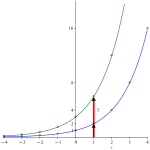
We can begin with \(x=1\text{,}\) from the table we know that \(2^1=2\text{,}\) so for this function we end up with \(3 (2^1) = 3 \cdot 2 = 6\text{.}\) On this function the point (1,2) moved to (1,6). We should check another point. Consider \(x=2\text{.}\) From the table we know that \(2^2=2\text{,}\) so for this function we end up with \(3(2^2) = 3(4) = 12\text{.}\) On this function the point (2,4) moved to (2,12).
If we look at the rest of the table, we see that every point has the same x value but the y value is triple (higher). This is different from adding 3 (bigger growth).
The horizontal axis ranges from -4 to 4. The vertical axis ranges from 0 to above 16. Tick marks on the vertical axis are each double the one below beginning at 1.
The points for both curves from the table above are plotted and graphs of the curves are sketched through them. For most of the points on \(y=2^x\) there is a corresponding point directly above it on \(y=3(2^x)\text{.}\) Because the graph of \(y=3(2^x)\) is too high to fit in the vertical range there are no corresponding points at \(x=3,4\text{.}\)
At \(x=1\) there is a vertical arrow of length 1 from the x-axis to the point on \(y=2^x\text{.}\) There is a second vertical arrow of length 3 there from the x-axis to the point on \(y=3(2^x)\text{.}\) Imagine the shorter arrow being stretched until it becomes the taller arrow. This is the effect that shifts points on one curve to the other.
We can begin with \(x=1\text{,}\) so \(-x = -1\text{.}\) This means that when we plug \(x=1\) into this function (\(2^{-x}\)) we get the same result (y value) as plugging \(x=-1\) into the function \(2^x\text{.}\) We can look that up in the table (or simply calculate) \(y=2^{-1}=0.5\text{.}\) On this function the point (-1,0.5) moved to (1,0.5).
Similarly for \(x=-1\text{,}\) so \(-x=-(-1)=1\text{.}\) This means that when we plug \(x=-1\) into this function (\(2^{-x}\)) we get the same result (y value) as plugging \(x=1\) into the function \(2^x\text{.}\) We can look that up in the table (or simply calculate) \(y=2^1=2\text{.}\) On this function the point (1,2) moved to (-1,2).
Comparing the results of these, two calculations we see that the points (1,2) and (-1,0.5) swapped position. We can try one more value to see if this continues. Consider \(x=4\text{.}\)\(-x=-4\text{.}\) Thus we obtain the same result as plugging \(x=-4\) into \(2^x\text{.}\) This gives us the point (4,0.0625) which used to be at (-4,0.0625). Again a point swapped sides. You can confirm this works on other points by completing the table below.
The horizontal axis ranges from -4 to 4. The vertical axis ranges from 0 to above 16. Tick marks on the vertical axis are each double the one below beginning at 1.
The points for both curves from the table above are plotted and graphs of the curves are sketched through them. For each of the points on \(y=2^x\) there is a corresponding point on the opposite side of the y-axis on \(y=2^(-x)\text{.}\)
There is a horizontal arrow starting at \((-1,\frac{1}{2})\) on the curve \(y=2^x\) that stretches to \((1,\frac{1}{2})\) on the curve \(y=2^{-x}\text{.}\) There is another horizontal arrow starting at \((1,2)\) on the curve \(y=2^x\) that stretches to \((-1,2)\) on the curve \(y=2^{-x}\text{.}\) These arrows illustrate how points on \(y=2^x\) have a corresponding point on \(y=2^{-x}\) which is on the opposite side of the y-axis.
We recognize that \(0.25=\frac{1}{4}\text{,}\) so for our first value we choose \(x=4\text{.}\) We calculate \(0.25(4)=1\text{.}\) This means that when we plug \(x=4\) into this function (\(2^{0.25x}\)) we get the same result (y value) as plugging in \(x=1\) to the function \(2^x\text{.}\) We can look that up in the table (or simply calculate) \(y=2^{0.25(4)}=2^1=2\text{.}\) On this function the point (1,2) moved to (4,2).
To understand the full effect, complete the table below using the same process. Because multiplying by 0.25 changes the x value, we have changed the x values in this table so that all points will match points in the table we are using.
The horizontal axis ranges from -16 to 16. Notice that this is 4 time wider than the previous examples. The vertical axis ranges from 0 to above 16. Tick marks on the vertical axis are each double the one below beginning at 1.
The points for both curves from the table above are plotted and graphs of the curves are sketched through them. For each of the points on \(y=2^x\) there is a corresponding point on \(y=2^(0.25x)\text{.}\)
There is a horizontal arrow starting at \((-1,\frac{1}{2})\) on the curve \(y=2^x\) that stretches to \((-4,\frac{1}{2})\) on the curve \(y=2^{0.25x}\text{.}\) There is another horizontal arrow starting at \((1,2)\) on the curve \(y=2^x\) that stretches to \((4,2)\) on the curve \(y=2^{0.25x}\text{.}\) These arrows illustrate how points on \(y=2^x\) have a corresponding point on \(y=2^{0.25x}\) which is 4 times as far away from the y-axis. This is why the horizontal axis is 4 times wider than previous examples.
The graph shows that we end up with the same y values, but they occur spread out over a wider area. Multiplying 0.25 by \(x\) stretched the curve horizontally. Because the number is between 0 and 1 (small fraction) it stretched it out. We could squeeze it in by multiplying by a number larger than one (e.g., \(2^{4x}\)).
where \(h\) and \(k\) represent the horizontal and vertical shifts respectively. \(A\) and \(B\) represent the vertical and horizontal stretches respectively. The first two examples below start by using each of these transformations individually. The third example illustrates using a shorter method that we typically use.
Graph the model \(7.000 \cdot 2^{-t/10.551}\) from Example 6.1.14. In order to match our examples above we can express the exponent as \(7.000 \cdot 2^{-0.094778t}\text{.}\) We simply calculated \(1/10.551\) and maintained 5 significant digits.
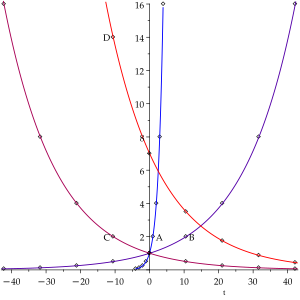
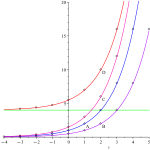
First, we identify the changes from \(y=2^t\text{.}\) The coefficient of the exponent is a horizontal stretch. The negative in the exponent is a reflection over the y-axis. The 7.000 in front is a vertical stretch. We can make these changes in order of operation: horizontal stretch, reflection, vertical stretch. These changes are shown one at a time in the figure below. Graph A is the original. B shows the horizontal stretch. C shows the reflection. D adds the vertical stretch. The labels are located to show how one point is transformed by each step.
The graph labeled A is of the original \(y=2^t\) which is shown as solid blue. The second graph labeled B is of \(y=2^{t/10.551}\) and is shown in short dashed dark purple. The third graph labeled C is of \(y=2^{-t/10.551}\) and is shown in slightly longer dashed magenta. The fourth graph labeled D is of \(y=7 \cdot 2^{-t/10.551}\) and is shown in long dashed red.
Looking at the final graph we can note that we really needed only three details to graph it. These are the asymptote (which remained unchanged from \(y=0\) here) and two points. One point tells us where to start and the other indicates how steep (because of the change between the two points).
First, we identify that this is a modified version of \(y=2^x\text{.}\) Next we identify the changes. The -1 is a horizontal shift. The 3 is a vertical stretch. The +4 is a vertical shift. We perform the changes in this order (following order of operations). These are shown in the graph below. Graph A is the original. B shows the horizontal shift. C shows the vertical stretch. D adds the vertical shift. The labels are located to show how one point is transformed by each step. Notice that the asymptote was moved up 4 units by the vertical shift as well.
The graph labeled A is of the original \(y=2^x\) which is shown as solid blue. The second graph labeled B is of \(y=2^{x-1}\) and is shown in short dashed dark purple. The third graph labeled C is of \(y=3(2^{x-1})\) and is shown in slightly longer dashed magenta. The fourth graph labeled D is of \(y=3 (2^{x-1})+4\) and is shown in long dashed red.
Again, we could have sketched the asymptote knowing only the vertical shift would change it. Then we could plot points at \(x=0,1\text{.}\) The curve is then sketched down to the left (to approach the asymptote) and up to the right with steepness determined by the second point.
Now that we have practiced using the various transformations, we can look at how a graph can be produced from just two, particular points. First, we consider that \(2^0=3^0=e^0=1\text{;}\) no matter the base the zeroth power is 1. Thus the first of the two points has the x coordinate such that the base is raised to the zero power. Second, we know that the asymptote is one unit below this point. Once we locate this first point, we can sketch the asymptote.
Third, we note that \(2^1=2\text{,}\)\(3^1=3\text{,}\)\(e^1=e\text{.}\) Thus the base can be determined by looking at the point with x coordinate one unit left/right from the first point. In the following example we use these three ideas to identify the shifts and reflection.
First, we calculate the x value where \(3^{x+2}=3^0\text{.}\) This is where \(x+2=0\) or \(x=-2\text{.}\) This implies that the curve is shifted to the left (we start graphing two left of zero instead of at zero). At \(x=-2\) we calculate \(y=6\text{.}\) We can plot this point.
Because this is an increasing exponential (positive exponent), the next point we want is one unit to the right. \(x=-2+1=-1\text{.}\) At this x value we calculate \(y=8\text{.}\) Because we know the asymptote is at \(y=5\text{,}\) we know this point is \(8-5=3\) units above the asymptote. This matches the base of 3 (i.e., the 3 in \(3^{x+2}+5\)).
So from these two points, we can determine the asymptote, the base, and the vertical shift. This is enough for graphing. When you graph exponentials in exercises you will enter these two points, and the software will calculate the rest using these ideas.
Similar ideas enable us to use just two points if we have horizontal or vertical stretches, but the explanation is more complicated than is useful in this text. We should be aware that a vertical stretch means the asymptote is not one unit beneath the first point (\(x=-2\) in the example above), because the stretch, stretches that distance. For example for \(3(2^{x-3})\) the asymptote is at \(y=0\text{,}\) the first, convenient point is at \(x=3\) which gives \(y=3\text{.}\) This is 3 above the asmyptote instead of just 1.
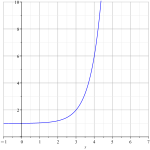
The graph begins on the left just above \(y=1\) and grows slowly until about \(x=2\text{.}\) It crosses through the point \((3,2)\) then begins to grow quickly as it continues to the right.
First, by looking at the left side of the graph we notice that the graph is always above \(y=1\text{.}\) This must be the asymptote. The asymptote gives us the vertical shift, i.e., \(k=1\text{.}\)
We know all exponential graphs have a point one unit higher (\(y=2\) in this case). This point occurs at \(x=3\text{.}\) Because this point on an unshifted exponential is at \(x=0\text{,}\) the horizontal shift \(h=3\text{.}\)
Finally, we can look one unit to the right of this point (\(x=4\)). The y value there is \(y=6\text{.}\) This is \(6-1=5\) units above the asymptote. This is the base \(b=5\text{.}\)
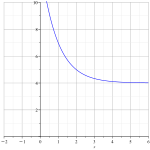
Second, because it is decreasing we know the asymptote will be on the right. All the points are above \(y=4\) thus the asymptote is \(y=4\text{.}\) The asymptote gives us the vertical shift, i.e., \(k=4\text{.}\)
We know there will be a point one unit higher (\(y=5\) in this case). This point is at \(x=2\text{.}\) This tell us the horizontal shift is \(h=2\text{.}\)
Finally, we can look one unit to the left of this point (\(x=1\)). The y value there is \(y=7\text{.}\) This is \(7-4=3\) units above the asymptote. This is the base \(b=3\text{.}\)
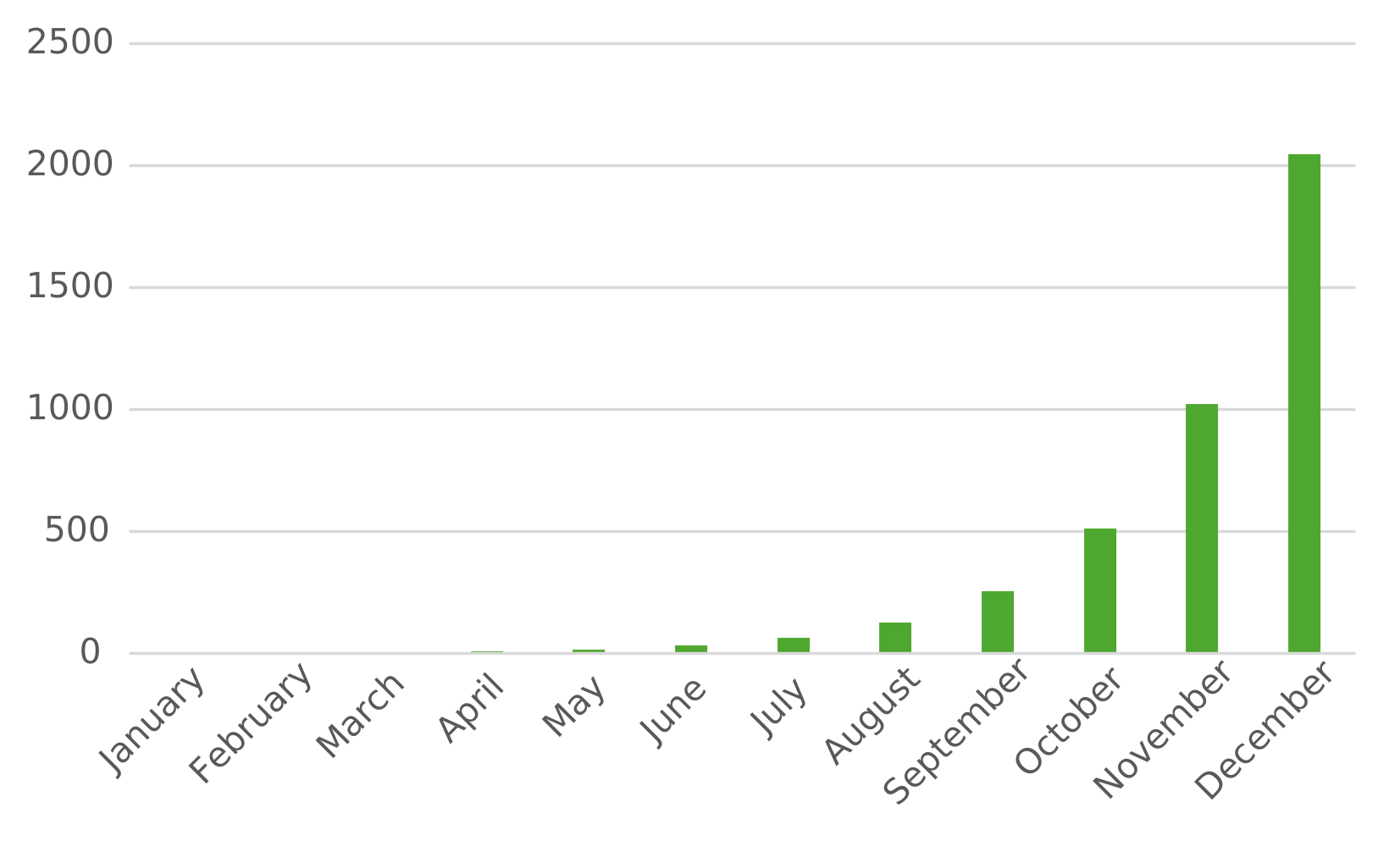
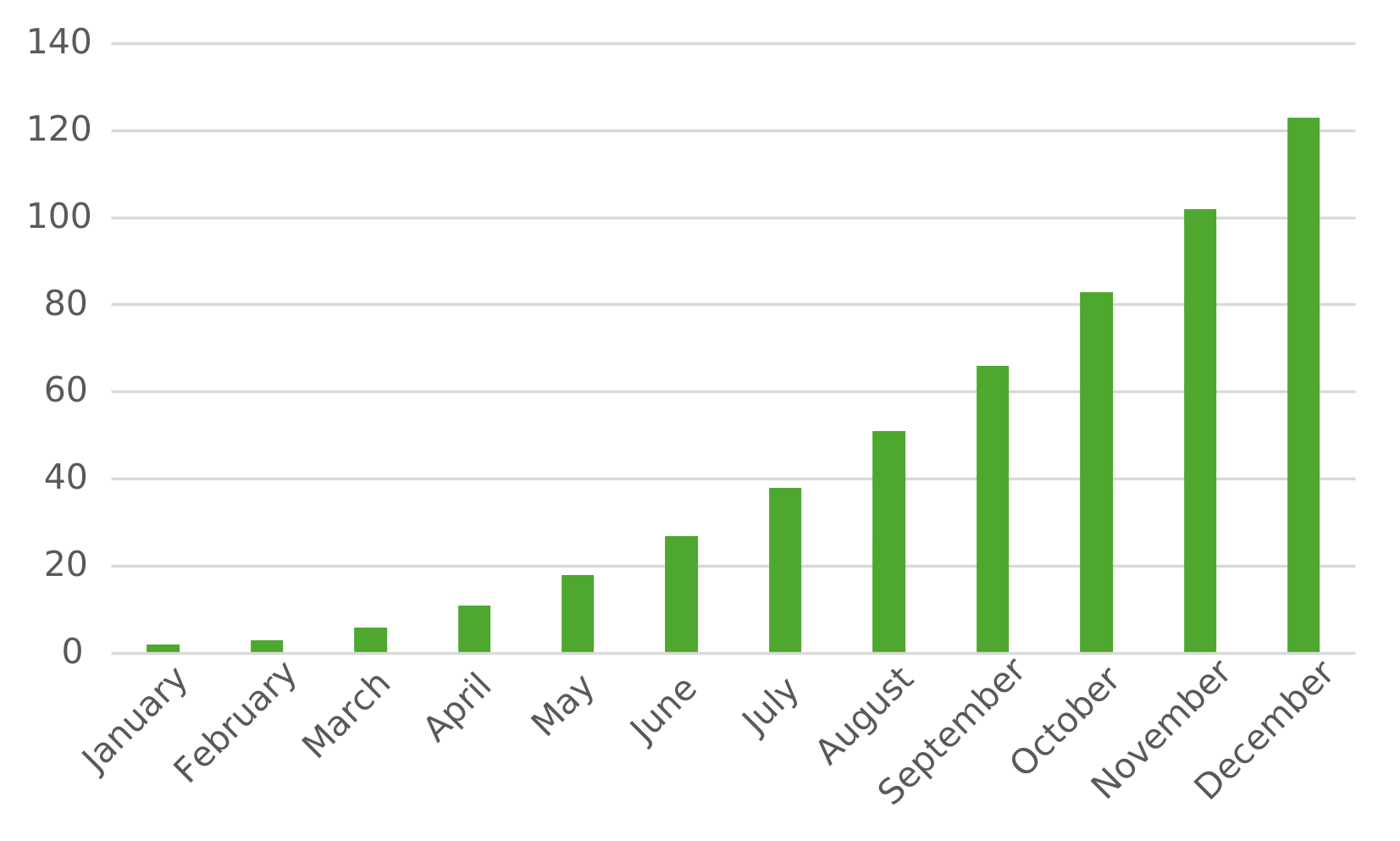
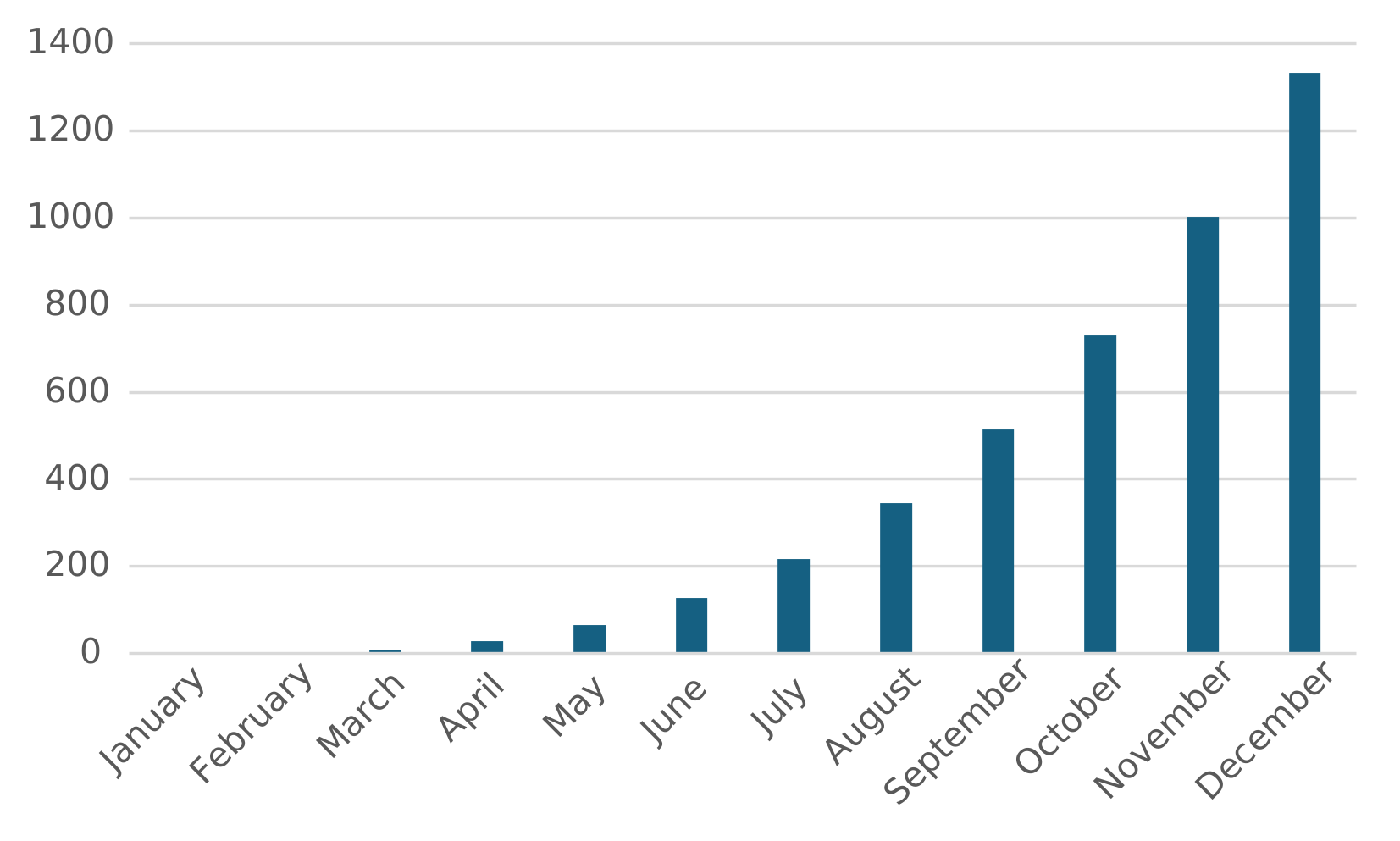
When we look at data, which may not be labeled as linear, quadratic, or exponential, how can we quickly determine which one it is? Look at the four examples below and try to determine which growth rate each has. Note one graph is a growth rate we have not covered.
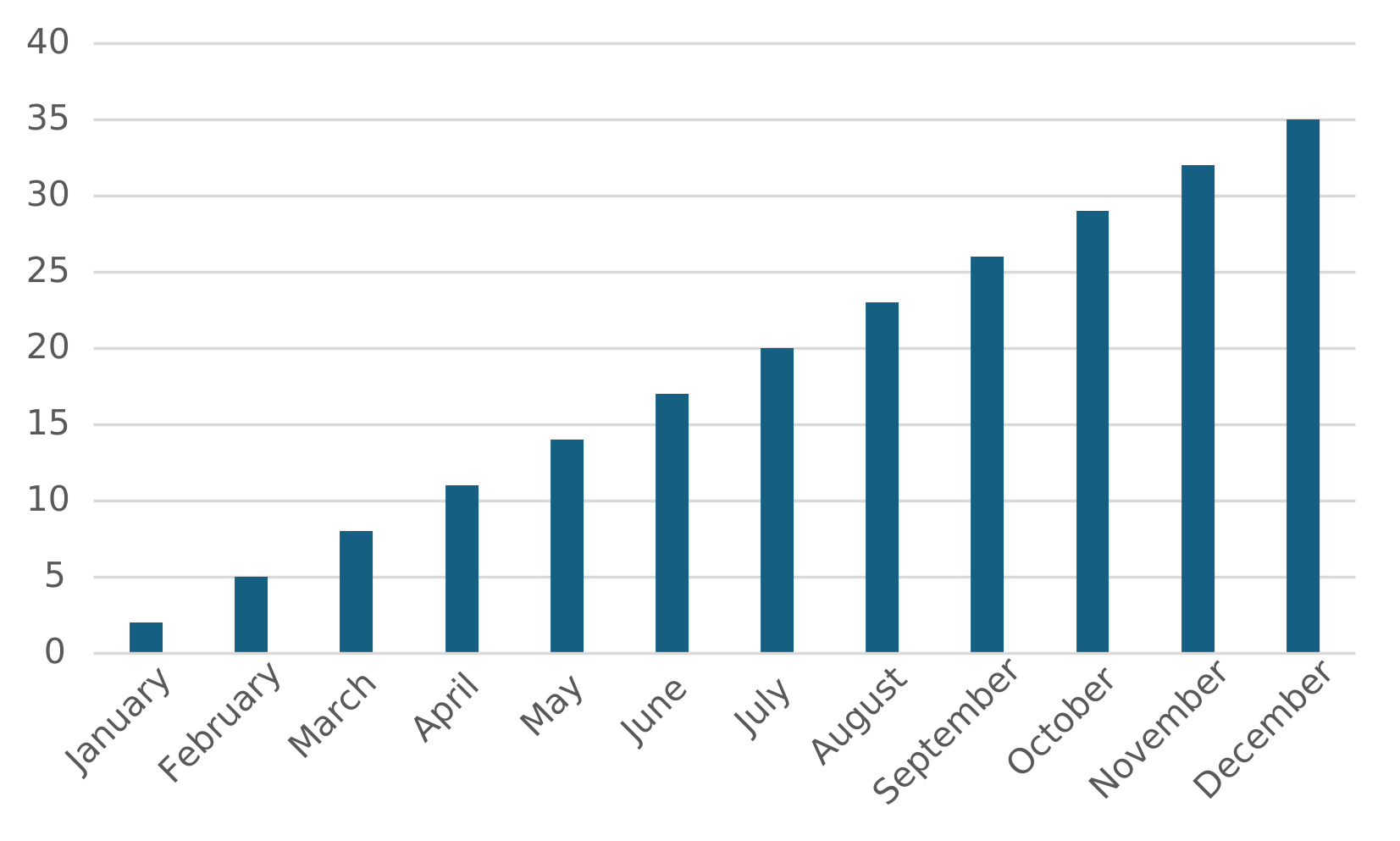
The January bar is about half way between 0 and 5. The February bar appears to be at 5. The March bar is a little more than half way between 5 and 10. As they continue each one appears to be either half way between or near the next multiple of 5.
A linear relationship is defined by the differences between pairs of data points being the same. On bar graphs this means the difference in height between consecutive bars must be the same. If we compare the change from January to February to the change from November to December we see that Figure 6.2.(b)–6.2.(d) they are vastly different (very small early and much larger later). For Figure 6.2.(a) however, the increase between bar heights looks the same. If we wished, we could use a ruler to measure and convince ourselves. This appears to be linear.
An exponential relationship can be recognized by the ratio between pairs of data points being the same. This is hard to use on a bar graph, because it means the height of each bar is a multiple of the previous. For example each bar would be 2 or 3 times as high. This would be hard to identify if each bar is 2.3 times as high however. Rather we will use two, alternative traits.
We know that the graph of an exponential is nearly flat in one direction and very steep in the other. Figure 6.2.(c) does not appear to flatten heading left. The bottom two graphs do have this flat appearance to the left. The other trait is that the differences of consecutive terms in an exponential relationship are the same scale as the entries. This means the change in height of consecutive bars should be on scale with the size of a bar. Consider September and October on Figure 6.2.(b). The change in height from September to October looks like the height of the September bar. In contrast the change in height from September to October in Figure 6.2.(d) is much less than the height of the September bar. Thus we can be convinced that the data in Figure 6.2.(b) is exponential and none of the others are.
We identify quadratic data by looking at the second differences. To do this on a bar graph would mean constructing a bar graph where each new bar’s height is the change in height of consecutive bars on the original graph. Then we would look if this new bar graph was linear. This is not a reasonable task. We would be better off asking for the original data.
The two bar graphs on the right have different relationships: one is quadratic, the other is not. Both can be described in the same terms (e.g., change in heights is increasing). This is a warning to not make many assumptions about data from limited data or simple graphs.